 EN
APP Waterproof Membrane: High-Temperature Stability Guide
2026/11/20
How an APP waterproof membrane handles heat: 130°C softening point, torch application windows, overheating signs, summer storage, and thermal aging checks.

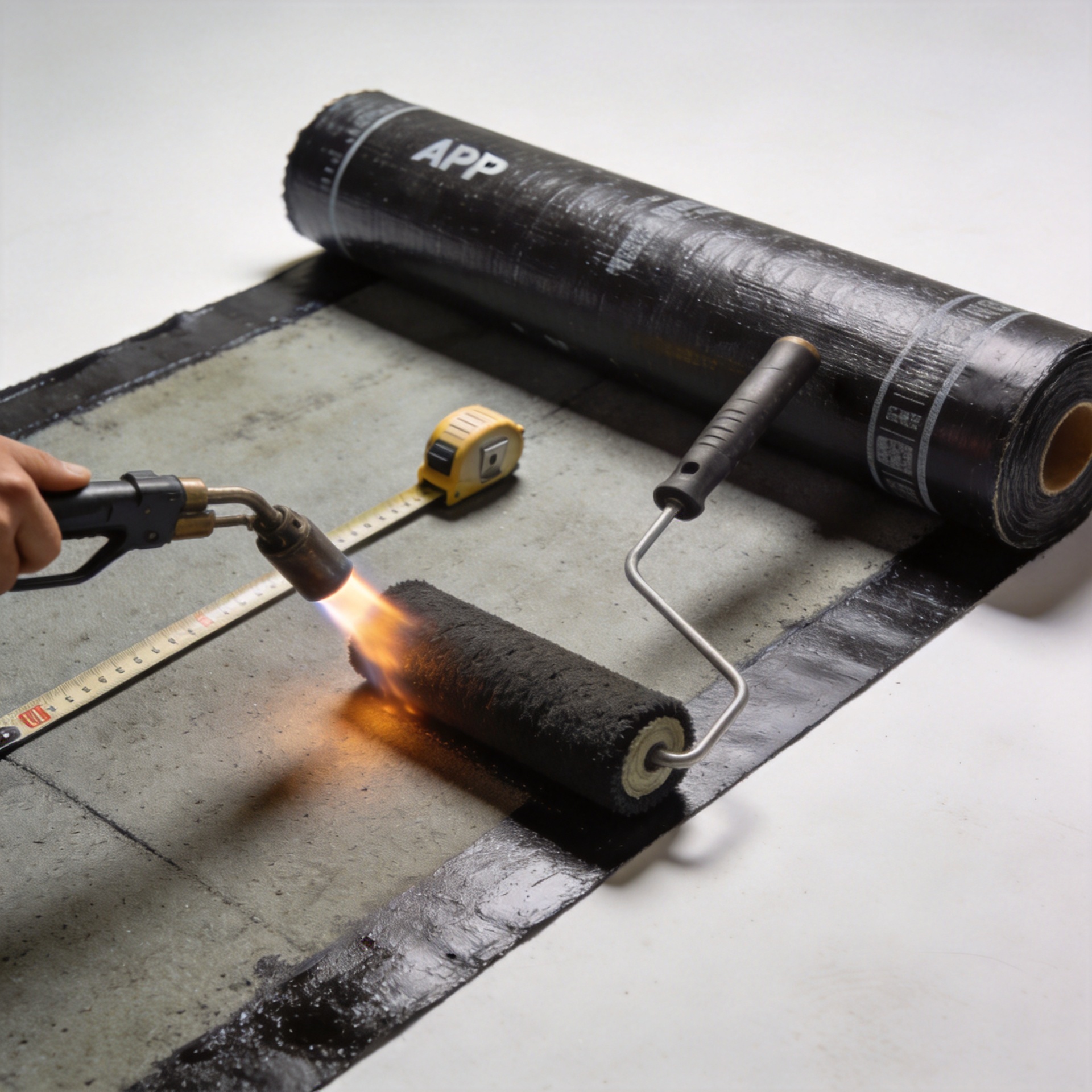
A polymer modified bitumen waterproofing membrane can be installed two ways on the same roof: torch-applied over large fields, and cold application at details with self-adhesive or adhesive systems. The hybrid scheme — flame for the field, cold bonding for the edges — lets one product serve both zones while respecting site fire rules. This guide explains why details suit cold bonding, how the zones meet, and where an all-cold or all-torch roof still wins.
The product in question is a polymer modified bitumen waterproofing membrane on polyester or fiberglass reinforcement, supplied 3mm, 4mm, or 5mm thick in 1m × 10m rolls, with tensile strength ≥600 N/50mm and elongation ≥25%. Its 130°C softening point and -5°C / -10°C flexibility suit exposed roofing.
Torch-applied roofing fuses rolls to a primed deck with controlled flame, keeping 80–100mm overlaps pressed fully. Cold application removes the flame entirely: a self-adhesive membrane bonds under pressure at ambient temperature, and the same APP bitumen membrane is also compatible with cold-adhesive installation where the specification allows, giving one polymer modified bitumen waterproofing membrane two installation routes.
Upstands, corners, pipe collars, and drainage outlets concentrate geometry, not area. Torch-applied roofing around an upstand works at awkward angles beside combustible finishes, and overheating can thin the compound where mass matters most. Cold application converts that risk profile: a self-adhesive membrane with peel adhesion ≥1.5 N/mm on concrete and flexibility to -20°C wraps corners and collars without any flame — detail work that complements the APP bitumen membrane field.
The published data supports the pairing. The 1.2mm self-adhesive sheet is water tight at 0.3 MPa for 120 minutes, and its PE film face accepts tile adhesive and screed directly. Where a detail moves — plinth edges, expansion joints — butyl strips carrying elongation ≥300% and a -40°C to +80°C window complete the cold-applied waterproofing zone.
A hybrid roof lives or dies at the junction where the torch field meets cold-bonded detail. Bitumen-to-bitumen contact between the APP bitumen membrane and a self-adhesive membrane is chemically compatible — both are modified bitumen compounds, so the lap self-welds under compression. Three rules keep the interface sound: cold details must overlap onto a clean, unoxidized torch surface or receive the torch-applied roofing lap over them; lap widths follow the 80–100mm membrane standard; and every hybrid lap is rolled and inspected with the same rigor as a field seam, keeping the cold application zone off oxidized surfaces.
Temperature rating matters at the junction. A polymer modified bitumen waterproofing membrane softens at 130°C, so flame must never play onto an already-bonded self-adhesive edge — sequencing, covered next, prevents that.
Order of work protects the cold zone. The standard sequence runs: prime the deck, torch the field rolls first while access is open, then form cold-applied waterproofing details onto the cooled field laps, and close terminations last. Where a detail must precede the field — plinths cast early, collars formed before rolls arrive — protect the cold-membrane edges with temporary battens so torch spillover misses the exposed adhesive face. On a port-side logistics hall re-roof, one crew torched the field in week one and closed forty upstands and collars with cold-bonded sheet in week two, without a single fire-watch shift.
A polymer modified bitumen waterproofing membrane gives the schedule a natural split: torch-applied roofing occupies the open, permitted phase of the programme, while cold application of details continues afterwards without fire watch, even into occupied or enclosed phases.
Acceptance divides along the same line as application. Torch zones are checked for full embedment, uniform lap bleed-out at edges, and the specified 80–100mm overlap; cold zones are checked for substrate preparation records, full release-liner removal, roller consolidation, and compression at every self-adhesive membrane lap. Each cold lap should show continuous contact, no dust bridging.
Document the split on a marked drawing: every polymer modified bitumen waterproofing membrane seam gets a field-seam entry, and every cold detail gets its own entry with an inspection date. This keeps mixed-method roofs auditable rather than assumed.
Hybrid work is not universal. All-torch roofing suits large, unoccupied decks with hot-work access and cold-climate schedules; where the -5°C / -10°C flexibility of APP is marginal, an SBS grade with flexibility to -25°C and tensile ≥800 N/50mm takes the field instead. All-cold application suits occupied hospitals, basements, and any site where flame permits are refused; there a self-adhesive membrane system carries the whole build-up instead of a polymer modified bitumen waterproofing membrane field, and the APP bitumen membrane waits for a site that can fire a torch.
Choose the hybrid when fire rules, detail density, and field size all fall in the middle — which describes most commercial re-roofs and the growth of cold-applied waterproofing detail work.
Yes. Both are modified bitumen compounds, so the cold lap bonds onto a clean torch surface, and 80–100mm laps are maintained. Sequence the torch work first so flame never touches an already-bonded self-adhesive edge.
Details concentrate angles and combustible adjacencies. A self-adhesive membrane with ≥1.5 N/mm peel adhesion wraps upstands and collars without flame risk, while the APP bitumen membrane handles the open field where torch-applied roofing works fast.
The cold-bonded details sit beside, not instead of, the field. The 130°C softening point of this polymer modified bitumen waterproofing membrane governs roof heat performance; self-adhesive membrane zones at -20°C flexibility serve details that are typically shaded or covered.

2026/11/20
How an APP waterproof membrane handles heat: 130°C softening point, torch application windows, overheating signs, summer storage, and thermal aging checks.

2026/11/20
The science of a breathable waterproof membrane: water vapor diffusion, Sd values, three grammage grades, water column resistance, and wrong-use cases.

2026/11/20
Single-ply or two-ply, every flat roof is a stack. See how a self adhesive waterproof membrane for roof systems handles base, cap, insulation and drains.

2026/11/20
How the polyester scrim sets tensile strength and dimensional stability of reinforced TPO membrane rolls, with welding, roll sizes and selection tips.

2026/11/20
How an aluminum foil coated bitumen waterproof membrane reflects solar radiation, lowers surface temperature, and what maintenance keeps savings alive.

2026/11/20
SBS modified bitumen waterproof membrane property groups: tensile strength, low-temperature flexibility, heat resistance, surface finishes, applications.
Links to the corresponding full news page.

The eight questions overseas buyers ask most — factory ownership, capacity, batch consistency and lead times, answered straight.

SBS membranes, polymer sheets, coatings and geomembranes — six product lines are operating simultaneously.

Pre-sales specification, on-site technical support and post-delivery maintenance across 100+ export markets.

Waterproofing performance is decided in the specification and the detailing, not just the material. Our technical team helps you select the right system, resolve site questions as they arise, and stay reachable long after the container lands.
