 EN
APP Waterproof Membrane: High-Temperature Stability Guide
2026/11/20
How an APP waterproof membrane handles heat: 130°C softening point, torch application windows, overheating signs, summer storage, and thermal aging checks.

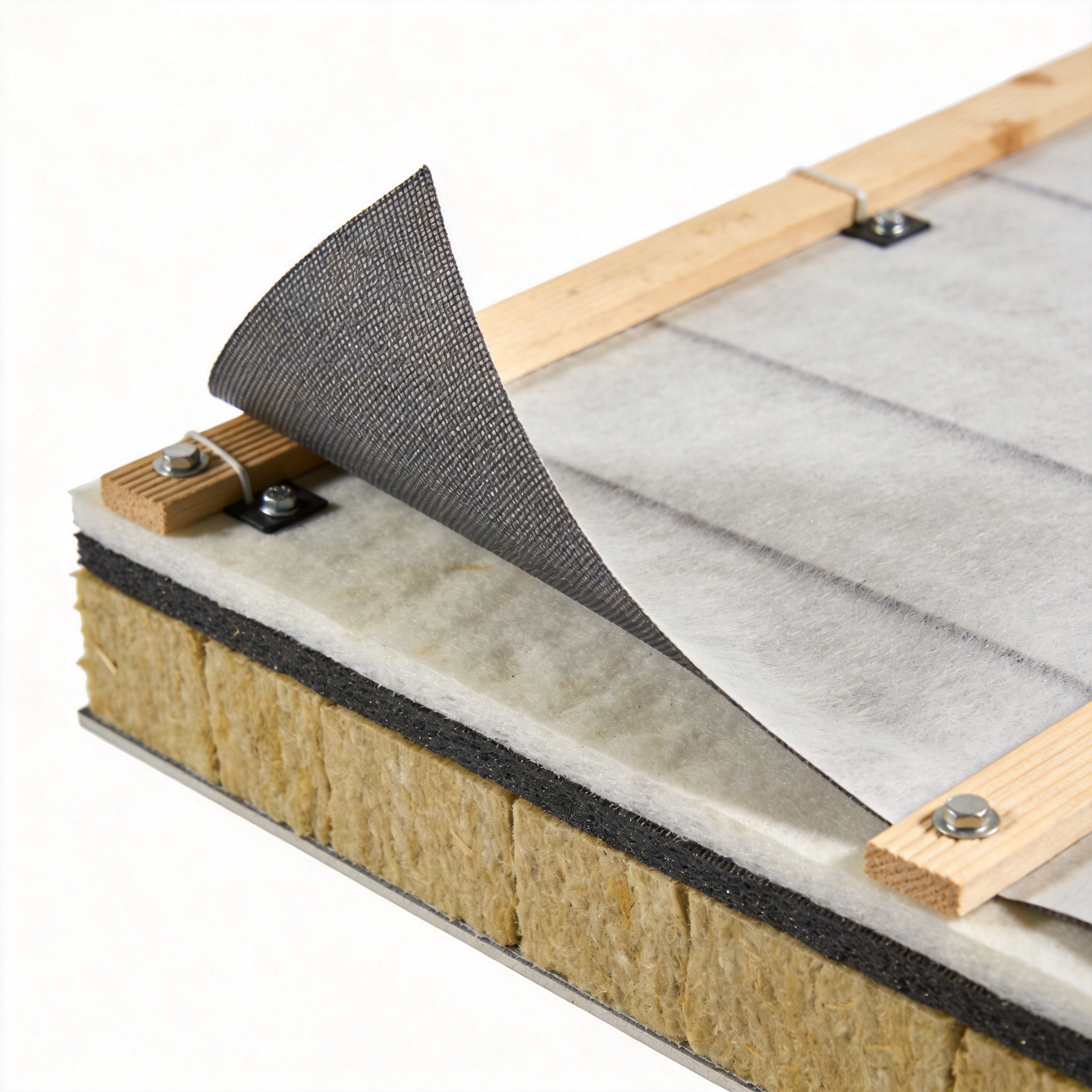
A breathable waterproof membrane for attic insulation sits on the cold side of a vented roof, above the mineral wool and under the tiles. The vapor control layer sits on the warm side, at ceiling level, and limits how much household moisture reaches the loft. A breathable roof underlay keeps rain out while vapour leaves; reverse the order and the assembly works against itself.
In a vented cold roof the thermal boundary sits at ceiling level, so the space above stays near outdoor temperature for most of the year. Moisture still arrives from bathrooms and kitchens, and it cools as it rises. The sheet over the rafters has to stop wind-driven rain and drifting snow from reaching the wool, which is why one grade is rated at ≥1,000 mm H₂O and another at ≥2,000 mm H₂O. That same breathable waterproof membrane for attic insulation must stay open at Sd ≤0.02 m, roughly a fiftieth of the resistance a closed barrier provides. Attic ventilation carries vapour off the cold face, yet attic condensation forms whenever arrival outruns removal.
It belongs on the warm side, which in a cold attic means across the ceiling joists, not across the rafters. It runs as one continuous plane, sealed to the wall plate and cut neatly around hatches, downlights and flues. Break that plane once and humid air bypasses it at a single point, where the local load can far exceed diffusion through the whole ceiling. A breathable waterproof membrane for attic insulation has no role in that plane; it sits above the wool. Attic ventilation will not repair a gap at a hatch frame, so attic condensation traced there is a plane problem.
Both products look alike in a roll and behave in opposite ways. A breathable roof underlay is deliberately open, rated Sd ≤0.02 m, so vapour crosses freely. A vapor barrier is deliberately closed and exists to stop that flow at the warm side. Fit the closed product over the rafters and moisture trapped beneath it has nowhere to go; fit the open product at ceiling level and the building loses its only plane. A breathable waterproof membrane for attic insulation is the open type by definition, and attic ventilation cannot compensate for a vapor control layer fitted at the wrong plane.
Mineral wool should touch the underside of the breathable roof underlay without being forced into it. A gap of a few centimetres opens a convection loop along the cold face, and the top of the wool never reaches its declared performance. Over-compression is the opposite error: squeezing a batt to clear a cable reduces thickness and thermal resistance exactly where heat loss concentrates. Neither mistake is visible from below. A breathable waterproof membrane for attic insulation cannot rescue compressed wool, and attic condensation blamed on the roof is often a batt pressed down at a joist. Where the vapor control layer is airtight but the wool is compressed, the ceiling still runs cold at that spot.
Attic ventilation only works when air enters low and leaves high. Soffit vents admit air at the eaves, the space above the wool carries it, and ridge vents discharge it. The path fails at predictable points: wool pushed into the eaves, boarding stored across joists, and membrane sagging between rafters until it closes the ridge gap. Each one stalls the flow, and a stalled attic holds moisture against the cold sheet long enough for frost to form. Frost is the visible end of the process that shows up as attic condensation in milder weather. Specifying a breathable waterproof membrane for attic insulation without clearing that inlet buys nothing: a breathable roof underlay laid over a blocked vent only traps what the baffle was meant to release. A vapor control layer will not change that, because the fault is air path rather than vapour path.
Water stains tell you which layer failed. Rusty nail heads in a line along a rafter, with clean sheathing between them, usually point to a lap letting water track sideways. A broad dark patch on the sheathing with the sheet below it dry points to the covering or a flashing. Frost on the underside of the sheet that clears by midday is attic condensation, not a leak. Check laps first, then penetrations, then the covering. The breathable roof underlay is the layer most often blamed and the least often at fault, and attic ventilation does not explain a stain that appears only after driving rain. A breathable waterproof membrane for attic insulation that is wet above and dry below has done its job.
No. The sheet controls rain and vapour diffusion; it does not move air. A vented cold roof still needs attic ventilation with an inlet and an outlet sized for that roof, and blocking either one creates problems a breathable roof underlay cannot solve.
Only where the assembly is designed as unvented, with the vapor control layer on the warm side and a verified drying path. Laid over wool in a vented attic it traps moisture in the coldest part of the build-up, and attic condensation appears within one heating season.
They differ in mass, strength and UV allowance: 70–100, 130–180 and 220–300 g/m², with ≥3, ≥4 and ≥6 months of exposure. Shandong Dingtai Waterproof supplies all three grades of breathable waterproof membrane for attic insulation from 10,000 m².

2026/11/20
How an APP waterproof membrane handles heat: 130°C softening point, torch application windows, overheating signs, summer storage, and thermal aging checks.

2026/11/20
The science of a breathable waterproof membrane: water vapor diffusion, Sd values, three grammage grades, water column resistance, and wrong-use cases.

2026/11/20
Single-ply or two-ply, every flat roof is a stack. See how a self adhesive waterproof membrane for roof systems handles base, cap, insulation and drains.

2026/11/20
How the polyester scrim sets tensile strength and dimensional stability of reinforced TPO membrane rolls, with welding, roll sizes and selection tips.

2026/11/20
How an aluminum foil coated bitumen waterproof membrane reflects solar radiation, lowers surface temperature, and what maintenance keeps savings alive.

2026/11/20
SBS modified bitumen waterproof membrane property groups: tensile strength, low-temperature flexibility, heat resistance, surface finishes, applications.
Links to the corresponding full news page.

The eight questions overseas buyers ask most — factory ownership, capacity, batch consistency and lead times, answered straight.

SBS membranes, polymer sheets, coatings and geomembranes — six product lines are operating simultaneously.

Pre-sales specification, on-site technical support and post-delivery maintenance across 100+ export markets.

Waterproofing performance is decided in the specification and the detailing, not just the material. Our technical team helps you select the right system, resolve site questions as they arise, and stay reachable long after the container lands.
