 EN
APP Waterproof Membrane: High-Temperature Stability Guide
2026/11/20
How an APP waterproof membrane handles heat: 130°C softening point, torch application windows, overheating signs, summer storage, and thermal aging checks.

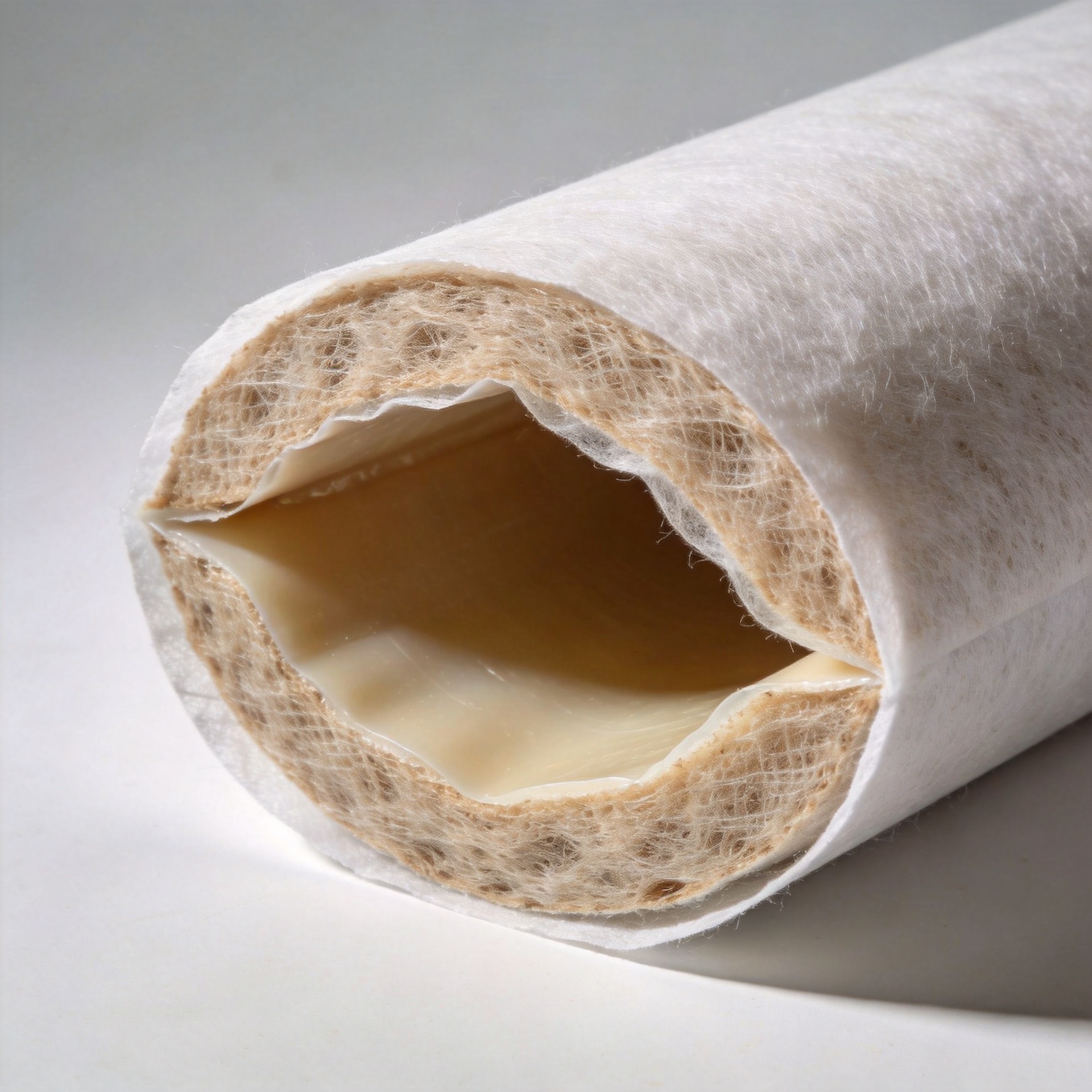
Waterproofing sheets are judged by the layer placed above them. A double sided non woven pp pe waterproof membrane answers that test at both faces: each surface carries polypropylene fabric, so a roll cannot be laid the wrong way up. This overview covers the build-up, the duty of each face, and the published range. A composite waterproof membrane is only as good as its two interfaces.
The description is literal. A polyethylene core sits at the centre, and a PP non-woven facing is thermally bonded to each surface. Neither face is a coating; both are fabric. That symmetry removes a familiar site error: there is no up side to track, and a cut piece can be turned without checking orientation. The double sided non woven pp pe waterproof membrane relies on that indifference, because the installer reads the substrate, not the roll.
The core is the barrier: a solid PE core film carries the water-tightness figure, and its continuity across the roll stops pressure-driven water. The facings are not waterproofing layers; they are the interface. Each PP non-woven facing protects the core, spreads point loads from aggregate or traffic, and offers a fibrous surface that cement paste can key into. Cementitious bonding succeeds or fails at that surface, not in the core. That is the whole case for a composite waterproof membrane with two fabric faces.
Both surfaces are fabric, so the difference between them is positional. The face against the substrate accepts the medium chosen for it: slurry on concrete, a mortar bed on a slab, or a primer in a bonded system. The outward face accepts whatever follows: a screed, a render, or a tile bed. That is the practical argument for the double sided non woven pp pe waterproof membrane. A sheet with fabric on one side and film on the other satisfies one interface only, so the film face must be bonded by heat while the PP non-woven facing carries the finish. Where both interfaces are cement-based, a single-faced roll turns cementitious bonding into a workmanship variable, and the composite waterproof membrane loses its consistency.
Single-faced sheets exist where a sheet must slip against a substrate, and there a film face is right. Where a bond is required at both interfaces, a single-faced product leaves one side dependent on adhesive, and the assembly behaves as a barrier plus two bond lines, not one integrated layer. A double facing collapses that into a single wet-bond operation, with no flame, no solvent, and no second trade, because cementitious bonding is the only bond line. Handling improves too: wrongly cut pieces can be turned, and one PP non-woven facing is as good as the other for receiving mortar. Those gains arrive without a thicker PE core film: the composite waterproof membrane fits the same build-up depth as the sheet it replaces, and the double sided non woven pp pe waterproof membrane needs no new fixing detail.
The range is arranged in three grades, differing in mass, thickness, and water-tightness pressure. On the medium-grade page of the polyethylene-propylene series, the published figures are tensile strength of at least 100 N/50mm, elongation at break of at least 150 percent, and water tightness at 0.4 MPa held for 30 minutes, tested to GB/T 17643. That page describes a PE core film with non-woven polypropylene on both surfaces: the build set out above. Source: Shandong Dingtai Waterproof, medium-grade page under polyethylene-propylene-waterproof-membrane on dtwaterproof.com.
The ladder shows where the material stops being a bond layer and becomes a structural barrier. The lightest grades serve duties where cementitious bonding and handling dominate; the heaviest meets sustained hydraulic pressure, with a denser PP non-woven facing and a thicker PE core film. Read side by side, the three pages show one progression, and the composite waterproof membrane family covers both ends without a change of logic.
Four items deserve written confirmation: the standard behind the figures, GB/T 17643, with CE marking and ISO 14001; the roll format, at widths of 1.0, 1.5, and 2.0 metres; the minimum order quantity, published at 500 square metres; and a certificate of analysis with each delivery, since a PP non-woven facing of the wrong mass still passes a visual check.
A civil contractor in Southeast Asia met that item on a utility building. Retaining walls had been specified with a single-faced sheet, and the site team was priming one face before backfill. Switching to the double sided non woven pp pe waterproof membrane removed the primer step and one inspection hold point, and cementitious bonding could be checked face by face before the wall closed. The composite waterproof membrane also arrived with a PE core film certificate matching the drawing.
Yes, though the layers can differ in mass. Both are polypropylene fibre bonded to a core, and the PP non-woven facing on the outer side may be specified heavier when the finish above is coarse.
Yes. Orientation does not change water tightness, because the barrier is the core. It changes only which surface meets the next material, and both faces accept cementitious bonding without a primer, which keeps the double sided non woven pp pe waterproof membrane reversible on site.
Not in the published data. Elongation at break is at least 150 percent on the medium grade, the facings are thin against the PE core film, and the sheet follows substrate contour. The composite waterproof membrane gains tensile strength, not stiffness.

2026/11/20
How an APP waterproof membrane handles heat: 130°C softening point, torch application windows, overheating signs, summer storage, and thermal aging checks.

2026/11/20
The science of a breathable waterproof membrane: water vapor diffusion, Sd values, three grammage grades, water column resistance, and wrong-use cases.

2026/11/20
Single-ply or two-ply, every flat roof is a stack. See how a self adhesive waterproof membrane for roof systems handles base, cap, insulation and drains.

2026/11/20
How the polyester scrim sets tensile strength and dimensional stability of reinforced TPO membrane rolls, with welding, roll sizes and selection tips.

2026/11/20
How an aluminum foil coated bitumen waterproof membrane reflects solar radiation, lowers surface temperature, and what maintenance keeps savings alive.

2026/11/20
SBS modified bitumen waterproof membrane property groups: tensile strength, low-temperature flexibility, heat resistance, surface finishes, applications.
Links to the corresponding full news page.

The eight questions overseas buyers ask most — factory ownership, capacity, batch consistency and lead times, answered straight.

SBS membranes, polymer sheets, coatings and geomembranes — six product lines are operating simultaneously.

Pre-sales specification, on-site technical support and post-delivery maintenance across 100+ export markets.

Waterproofing performance is decided in the specification and the detailing, not just the material. Our technical team helps you select the right system, resolve site questions as they arise, and stay reachable long after the container lands.
