 EN
APP Waterproof Membrane: High-Temperature Stability Guide
2026/11/20
How an APP waterproof membrane handles heat: 130°C softening point, torch application windows, overheating signs, summer storage, and thermal aging checks.

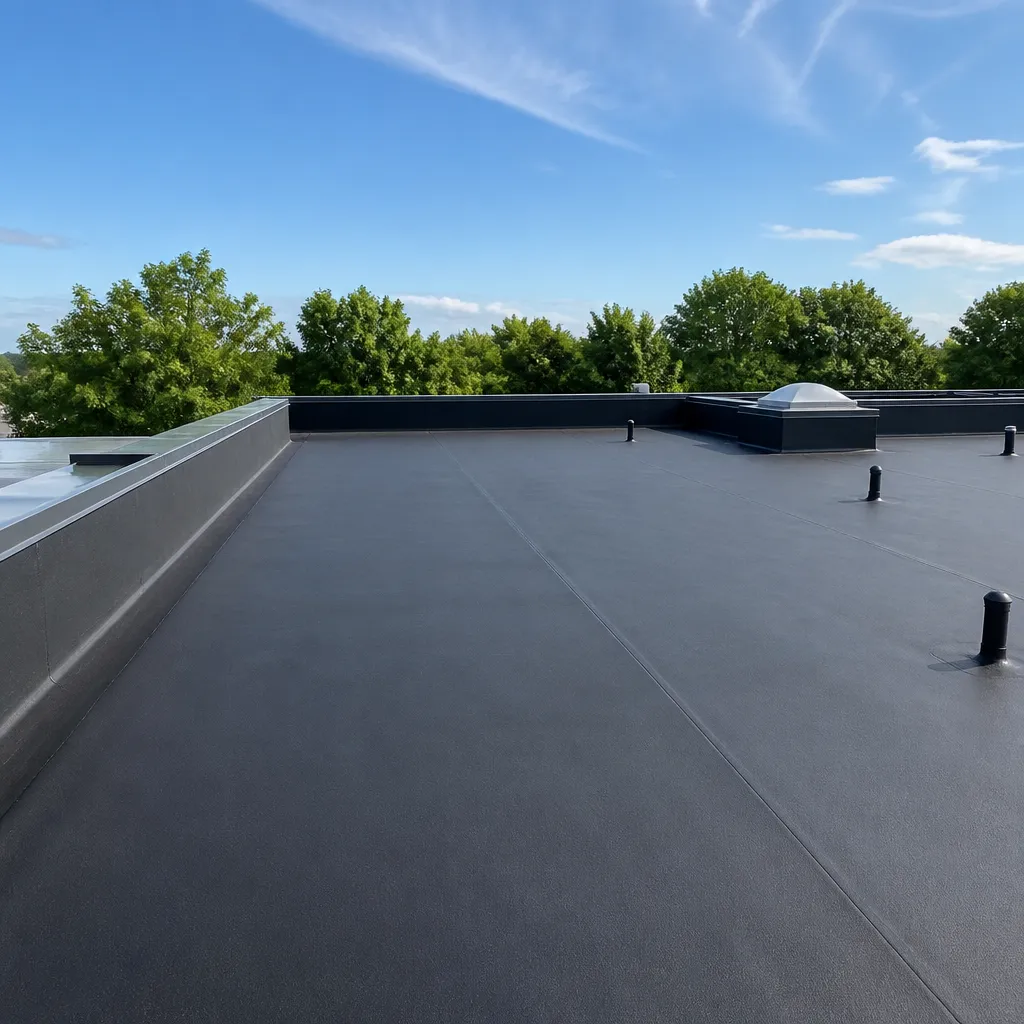
A planted roof fails from below more often than from above. The plants survive; what fails is the assembly beneath them — insulation turned into a drainage path, a waterproofing seam lifted, a deck taking water it was never designed to see. A green roof root barrier membrane is the layer that interrupts that sequence. This guide covers what a green roof root barrier membrane must do, which values decide whether it works, and where installations fail.
Roots follow water. On a planted roof the medium is irrigated at the surface, but moisture is never uniform: water percolates down and collects just above the drainage layer. Root tips gather there. A wrinkle at a seam, a cut left by a later trade, an unsealed collar around an outlet — each is a starting point, and each becomes a slow water path into the insulation. On an intensive assembly with 300 mm of growing medium, the root mass finds any weak point within a few seasons, which is why a root barrier layer is judged at its seams rather than mid-panel.
Three duties, often confused. Physical exclusion comes first: the root barrier layer must be continuous and non-fibrous, and high-density polyethylene qualifies because it is dense, non-porous and inert. Protection comes second: the same root barrier layer absorbs construction traffic, aggregate point loads and substrate movement before they reach the waterproofing. Hydraulic separation comes third: a root barrier layer must work with the drainage board so the root zone never stays saturated, because wet medium keeps roots active at the membrane face. Get the third wrong and root puncture resistance is never properly tested.
When comparing a green roof root barrier membrane, the data sheet answers most of the risk questions. Published values for an HDPE root barrier are: thickness 0.5 / 0.75 / 1.0 / 1.5 / 2.0 / 2.5 / 3.0 mm; width 1–8 m and roll length 10–100 m, customizable; tensile strength at yield of at least 15 kN/m at 1.5 mm to ASTM D6693; elongation at break of at least 700%; carbon black content of at least 2%; smooth, single-textured or double-textured surfaces; CE, ISO 9001, ISO 14001 and GRI-GM13 documentation.
Elongation of 700% lets the sheet follow movement between deck and insulation without cracking, and carbon black at 2% keeps an HDPE root barrier stable under UV during exposure before planting. Thickness for an HDPE root barrier follows planting load and the protection above it, not price. Width matters too: every field weld is a potential root entry point, so fewer panels are durability, not only labour saving.
From the plants down: vegetation, medium, filter geotextile, drainage board, protection fabric, root barrier, waterproofing, insulation, deck. The board and the barrier are not interchangeable, and neither replaces the HDPE root barrier. A 20–25 mm stud-height HDPE board carries at least 300 kPa of compressive load with longitudinal flow of at least 15–20 cm³/s — that is green roof drainage capacity and load transfer, not root exclusion. The 300–500 g/m² non-woven fabric below it, 2.5–4.0 mm thick, opening size 0.05–0.2 mm, cushions the membrane against puncture from aggregate and roots — the first line of root puncture resistance. Green roof drainage depends on that sequence: fabric laps facing the flow, seams welded rather than laid dry, nothing over a wet substrate.
A podium deck over parking shows the sequence. Waterproofing was inspected first; then the HDPE root barrier went down in long panels and was welded, each seam tested before the protection fabric followed. Root puncture resistance is settled here, not later — the crew walked every seam of the HDPE root barrier, checked collars at each outlet and planter drain, and stopped when rain left standing water. A second green roof drainage check confirmed water reached the outlets instead of ponding. The root barrier layer was marked on the as-built drawings by panel number.
Most failures traced back to a green roof root barrier membrane are detail failures: penetrations, upstands, outlet flanges, and the boundary between planted and paved areas. That is where continuity breaks, and where a green roof root barrier membrane gets patched rather than terminated. Later work reopens the question, so the finished roof should carry a marked plan of the barrier layout. Root puncture resistance depends on that record as much as on the sheet. Ask for CE, ISO 9001, ISO 14001, GRI-GM13 reports for the membrane and EN 13251 reports for the geotextile, plus batch COA, TDS and MSDS.
Not through an intact sheet. HDPE is dense and non-porous; roots cannot penetrate it chemically or mechanically. Failures occur at seams, at damaged areas, and where the sheet was cut and never sealed — which is why root puncture resistance testing at seams decides more green roof root barrier membrane outcomes than thickness does.
The published range for an HDPE root barrier is 0.5 mm to 3.0 mm across seven standard thicknesses. Selection follows planting intensity, the protection layers above and below, and the risk of later work — not price. The range is a menu, not a ranking.
No. Its published duty is green roof drainage and load transfer: at least 300 kPa compressive resistance and 15–20 cm³/s flow in the standard 20–25 mm grade. Puncture strength of at least 385 N covers construction loads, not root exclusion. Green roof drainage detailing stays subordinate to one rule — the root barrier layer remains continuous beneath both.

2026/11/20
How an APP waterproof membrane handles heat: 130°C softening point, torch application windows, overheating signs, summer storage, and thermal aging checks.

2026/11/20
The science of a breathable waterproof membrane: water vapor diffusion, Sd values, three grammage grades, water column resistance, and wrong-use cases.

2026/11/20
Single-ply or two-ply, every flat roof is a stack. See how a self adhesive waterproof membrane for roof systems handles base, cap, insulation and drains.

2026/11/20
How the polyester scrim sets tensile strength and dimensional stability of reinforced TPO membrane rolls, with welding, roll sizes and selection tips.

2026/11/20
How an aluminum foil coated bitumen waterproof membrane reflects solar radiation, lowers surface temperature, and what maintenance keeps savings alive.

2026/11/20
SBS modified bitumen waterproof membrane property groups: tensile strength, low-temperature flexibility, heat resistance, surface finishes, applications.
Links to the corresponding full news page.

The eight questions overseas buyers ask most — factory ownership, capacity, batch consistency and lead times, answered straight.

SBS membranes, polymer sheets, coatings and geomembranes — six product lines are operating simultaneously.

Pre-sales specification, on-site technical support and post-delivery maintenance across 100+ export markets.

Waterproofing performance is decided in the specification and the detailing, not just the material. Our technical team helps you select the right system, resolve site questions as they arise, and stay reachable long after the container lands.
