 EN
APP Waterproof Membrane: High-Temperature Stability Guide
2026/11/20
How an APP waterproof membrane handles heat: 130°C softening point, torch application windows, overheating signs, summer storage, and thermal aging checks.

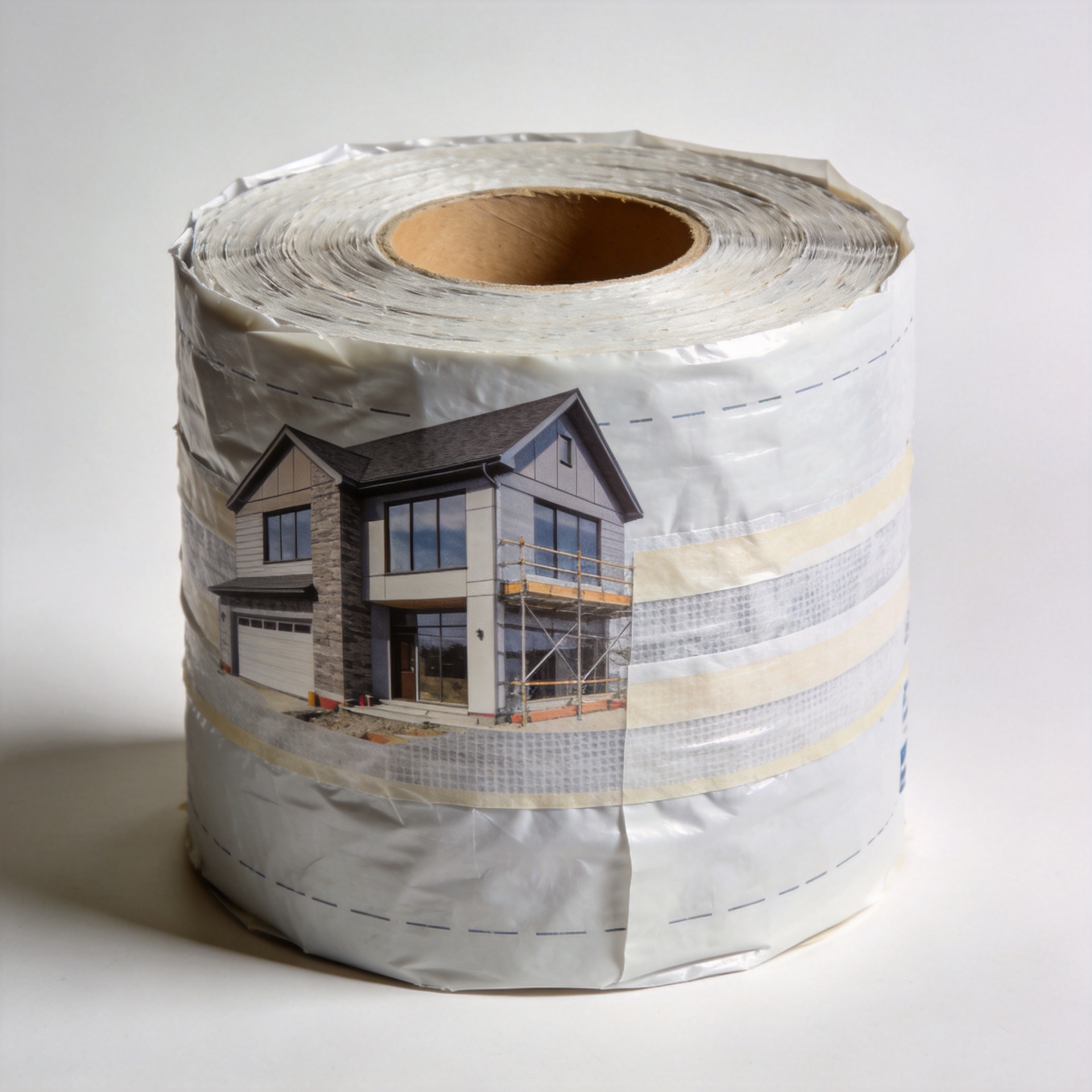
Behind every finished facade sits a layer visitors rarely see. A house wrap breathable waterproof membrane roll is that layer: the weather resistive barrier of the wall, blocking rain while letting vapor escape outward. This article explains its role in the building envelope, the numbers behind it, and the installation order that makes it work.
Cladding leaks; that assumption should shape every wall assembly behind brick slips, timber boards, or fiber cement panels. Wind-driven rain that passes joints in the outer skin must be stopped before it reaches insulation and sheathing, and that is the task of a weather resistive barrier. A house wrap breathable waterproof membrane roll performs this task while staying vapor permeable, so the same layer that sheds that rain also lets the cavity release moisture. One layer takes two jobs; drop either from the specification and the other fails quietly.
The two functions run in opposite directions. Outward, the wrap repels wind-driven rain that reaches the cavity; the three-layer structure of PP non-woven, PE film, and PP non-woven gives hydrostatic resistance starting at 1,000 mm H₂O even in the lightest grade. Inward, the film is vapor permeable down to an Sd value of 0.02 m, so moisture generated inside the building diffuses out instead of condensing on cold sheathing within the wall assembly. A weather resistive barrier that trapped vapor would move the decay problem rather than solve it. Specifying a house wrap breathable waterproof membrane roll therefore means checking both numbers: water column and Sd value.
Wet insulation loses thermal value quickly, and a saturated cavity can stay damp for months without a vapor-open layer. Because the wrap is vapor permeable, the wall assembly dries outward after wetting events, keeping mineral wool or PIR close to its designed performance. In heating seasons, moisture pushed outward by indoor humidity meets the coldest surfaces first; a vapor-open outer layer gives it an exit before it accumulates. Renovations gain the same benefit, since older walls often hold construction moisture for years. A weather resistive barrier therefore belongs in the energy chapter of a specification, not only the waterproofing one: dry insulation, lower heating demand, and fewer condensation complaints follow from the same drawing note.
Construction phases, not service years, are when the wrap takes its hardest beating. On one coastal housing site, an anonymous crew left wraps exposed two stormy months before cladding arrived; the light grade survived, and the contractor now defaults to the heavy grade on exposed elevations. A light wrap that stays vapor permeable through a wet spring is doing both jobs at once. That heavy grade carries tensile strength of at least 250 N/50mm and an exposure window of roughly 6 months, against 3 and 4 months on the light and medium lines, so a weather resistive barrier can be matched to the cladding schedule with evidence, not hope. For exposed sites, a house wrap breathable waterproof membrane roll from the heavy line holds wind-driven rain pressure and gust uplift at fastening points while staying vapor permeable behind the future skin.
Sequence matters more than strength. Hang the wrap from the base upward so upper laps shed over lower ones, keep horizontal laps generous, and turn vertical laps shingle-style around openings. Stagger T-joints so three seams do not meet at one point. Cut window and door openings in an I or H pattern, fold the resulting flaps inward, and tape them to the rough opening before flashing goes on, so wind-driven rain passing the frame drains onto the wrap, not into the cavity. Because the wrap stays vapor permeable even where taped, detailing the openings this way keeps the drying path of the wall assembly intact. A house wrap breathable waterproof membrane roll left unbattened on an exposed elevation will work its laps loose in gusts, so follow the manufacturer's fixing pattern. Battened correctly, the wrap sheds gusts and stays wind tight through the exposure window. Where battens form part of the cladding, they double as the permanent fixing line, and the wrap should be checked at each batten line for nail-gun tears.
Once the skin hides the layer, only evidence remains. Photograph every lap, opening, and tape joint; walk each elevation and confirm laps run in the shedding direction against wind-driven rain; check for unrepaired punctures and unrolled tape. Record grade and batch on the inspection sheet so the wall assembly file shows which product sits behind each facade. Include every roll's batch label in at least one photograph, and file the delivery notes alongside. A weather resistive barrier documented this way, traced from batch to elevation, hands the following trades a dry and defensible base.
No. The wrap is vapor permeable by design and manages outward drying; interior vapor control is a separate layer decided by climate and building use. In cold climates the interior layer is usually the tighter one; in warm humid climates the balance shifts, and both layers are chosen together.
The heavy grade, with tensile strength of at least 250 N/50mm and roughly 6 months of UV exposure, is written for that case. A roll from that line still serves as a weather resistive barrier with full vapor permeability, and its exposure window matches slow cladding schedules.
Yes, where the product data sheet calls for it. Taping closes the capillary path that wind-driven rain finds fastest, keeps the wall assembly tight through the exposure window, and leaves the house wrap breathable waterproof membrane roll continuous until the skin goes on.

2026/11/20
How an APP waterproof membrane handles heat: 130°C softening point, torch application windows, overheating signs, summer storage, and thermal aging checks.

2026/11/20
The science of a breathable waterproof membrane: water vapor diffusion, Sd values, three grammage grades, water column resistance, and wrong-use cases.

2026/11/20
Single-ply or two-ply, every flat roof is a stack. See how a self adhesive waterproof membrane for roof systems handles base, cap, insulation and drains.

2026/11/20
How the polyester scrim sets tensile strength and dimensional stability of reinforced TPO membrane rolls, with welding, roll sizes and selection tips.

2026/11/20
How an aluminum foil coated bitumen waterproof membrane reflects solar radiation, lowers surface temperature, and what maintenance keeps savings alive.

2026/11/20
SBS modified bitumen waterproof membrane property groups: tensile strength, low-temperature flexibility, heat resistance, surface finishes, applications.
Links to the corresponding full news page.

The eight questions overseas buyers ask most — factory ownership, capacity, batch consistency and lead times, answered straight.

SBS membranes, polymer sheets, coatings and geomembranes — six product lines are operating simultaneously.

Pre-sales specification, on-site technical support and post-delivery maintenance across 100+ export markets.

Waterproofing performance is decided in the specification and the detailing, not just the material. Our technical team helps you select the right system, resolve site questions as they arise, and stay reachable long after the container lands.
