
 EN
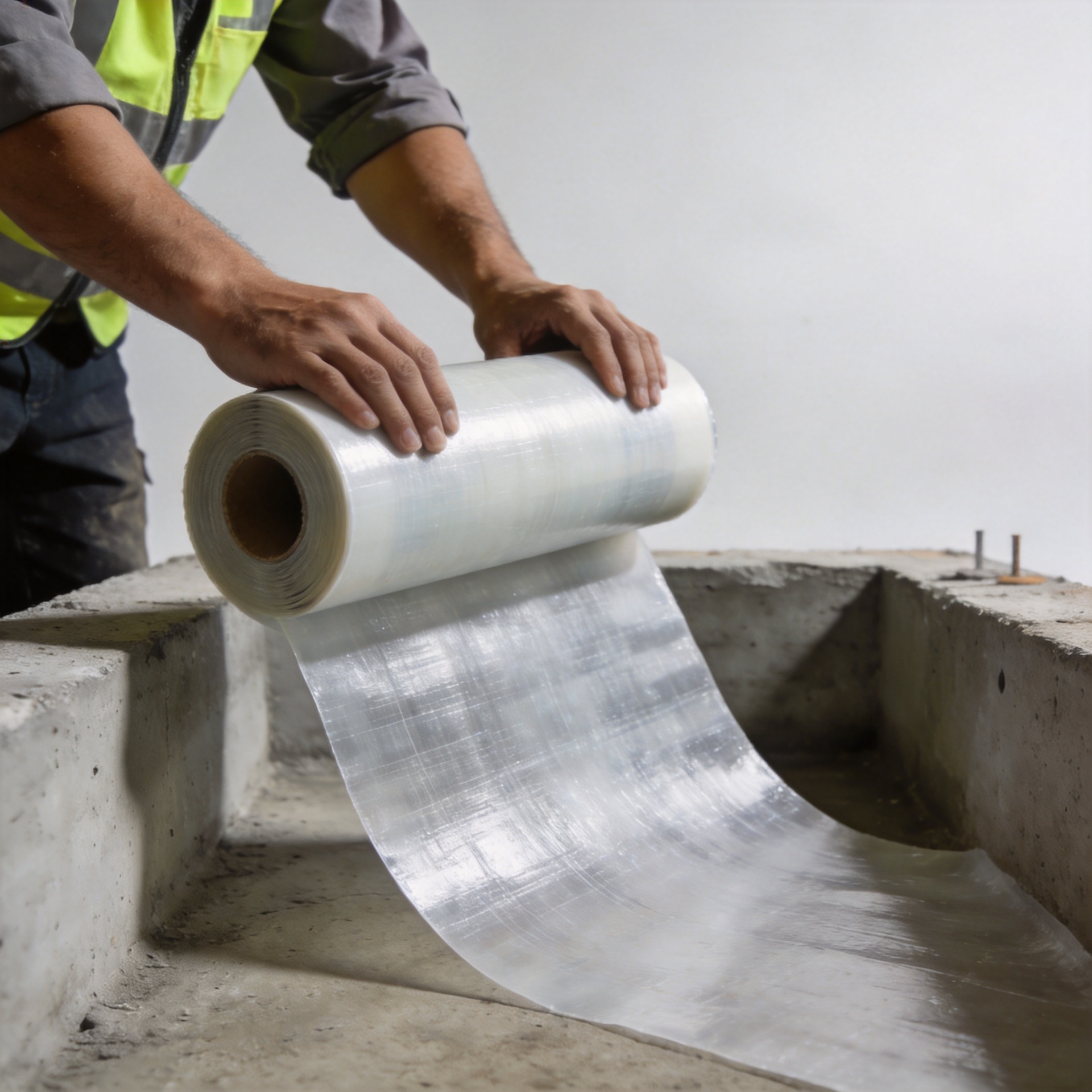
Drawings specify performance; site work decides whether it is delivered. This guide follows a PE polypropylene polymer composite membrane from the delivery bay to the handover signature: what the deck must be, how the sheet is laid, how laps close, how details form, and what an inspector should be shown. Material structure is covered elsewhere. Substrate acceptance, cementitious slurry bonding and lap discipline are the whole subject here.
Delivery Checks and Storage
Begin with the paperwork on the pallet. The three published grades differ enough that a mixed delivery is a real risk: lightweight at 100–200 g/m² and 0.3–0.5mm, medium at 300–400 g/m² and 0.6–0.8mm, heavy at 500–600 g/m² and 1.0mm. Confirm weight, thickness and water tightness band — 0.3, 0.4 or 0.6 MPa by grade — before a PE polypropylene polymer composite membrane is cut; substrate acceptance starts with that check. Widths run 1.0m, 1.5m and 2.0m, lengths from 10m to 100m, so set the roll schedule against the pour layout. Store upright and under cover: a composite waterproofing sheet left in sun for a week curls at the edges, and roller pressure will not flatten it again.
Deck Conditions and Surface Preparation
Most failures are made here, before the first roll is opened. Concrete under a PE polypropylene polymer composite membrane must be sound, free of laitance, dust, oil and curing compound, with tie holes cut back and filled. Texture matters more than flatness: a glossy trowel finish gives the composite waterproofing sheet nothing to grip, so scarify or brush it. Moisture is the subtle variable, because the bond is a suction bond, and a saturated slab looks much like damp one at dusk. Substrate acceptance also means checking the programme against the declared −20°C to 70°C service window and stopping if the deck is frozen. Cementitious slurry bonding cannot rescue a surface nobody inspected.
Setting Out and Pre-Laying
Unroll each length of PE polypropylene polymer composite membrane and let it relax flat before positioning. Mark lap lines rather than eyeballing them, because the membrane overlap width is 50mm or more and a chalk line at that offset keeps the grid honest across a wide deck. Plan runs so end laps sit on supported zones and stagger them between adjacent rows. Cut upturns and collars from offcuts rather than folding the composite waterproofing sheet into a corner. On a basement slab in an occupied apartment block, one crew pre-cut and numbered every length per bay; the dry run exposed two dimension errors before slurry was spread. That hour saved a day, and substrate acceptance paperwork was signed before the first bucket was mixed.
Bonding the Sheet
The method is one continuous operation and it tolerates no pause. Dampen the deck, apply the first coat of polymer-modified cementitious slurry at even thickness, and lay the composite waterproofing sheet PP-face down while it is still workable. Cementitious slurry bonding works by interlock: the fibre face must meet wet material, not a skin that has already formed. Press from the centre outward, roll the full area to expel air, then apply the second coat over the top face at once, encapsulating the PE polypropylene polymer composite membrane in a single wet-on-wet sequence. Where a bay cannot be finished in one pass, stop on a lap line and never mid-field.
Closing Laps and Forming Details
Roll every lap from the middle of the joint outward. Check membrane overlap width at intervals with a rule, not by eye, and cut out any joint under 50mm rather than patching it. Inside corners take a fillet first, outside corners are chamfered, and penetrations are detailed with a collar cut from the same sheet and dressed onto the field with a full lap all round. Terminations at walls and upstands run into a chase and are sealed, so the edge is protected instead of left as a glued lip. No fastener passes through the field of the sheet here; cementitious slurry bonding carries it, substrate acceptance proved the surface, and the membrane overlap width at every joint does the rest.
Curing, Protection and Water Test
Leave the composite waterproofing sheet assembly 24 to 48 hours before screed, tile adhesive or a protection layer goes on, and keep traffic off it. Then flood-test wet areas and inspect before covering: look for damp patches at laps and around collars, then collect the membrane overlap width readings taken during the work, and confirm substrate acceptance was signed off bay by bay. On that apartment refurbishment the inspection sheet listed each bay, its lap readings and the slurry batch, so the client's engineer signed off in one visit. A PE polypropylene polymer composite membrane covered without a record is a layer nobody can verify afterwards, which is why the file matters as much as the roll.
Frequently Asked Questions
How wet should the deck be before laying?
Matt and damp, with no standing water and no dry suction. Too dry pulls water from the slurry before the fibre face can interlock; too wet dilutes it. Either way cementitious slurry bonding fails months later, and the composite waterproofing sheet looked sound on the day.
Can a lap be widened to use up an offcut?
No. A generous membrane overlap width adds nothing and traps slurry at the joint. Keep 50mm minimum, replace short laps, and reserve offcuts for collars and corners; substrate acceptance does not extend to improvising joints.
Is a protection layer always required?
Over trafficable and tiled areas, yes. A PE polypropylene polymer composite membrane is a bonded layer inside the build-up, so screed or tile bed shields it while the composite waterproofing sheet does the sealing, and no membrane overlap width or cementitious slurry bonding detail compensates for a missing cover.










