 EN
APP Waterproof Membrane: High-Temperature Stability Guide
2026/11/20
How an APP waterproof membrane handles heat: 130°C softening point, torch application windows, overheating signs, summer storage, and thermal aging checks.

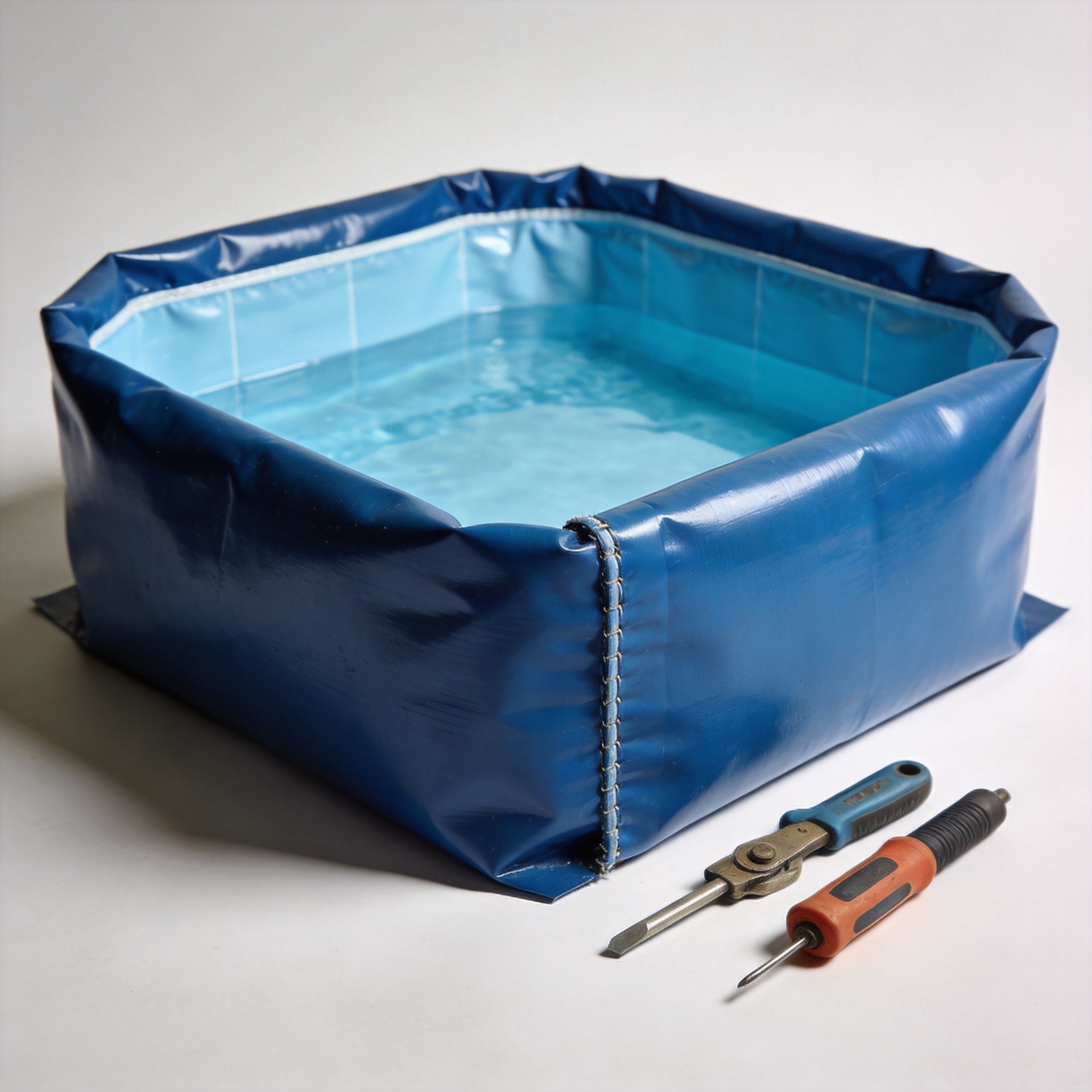
A pool is a vessel, not a roof. A swimming pool liner keeps water in rather than out, stays wet on one face all year and is walked on during cleaning. Pool waterproofing is judged on two questions: what the sheet does mechanically under a fixed head, and what the water does to it over time. A pvc waterproof membrane for swimming pool work answers the first with published values, and the second needs a test report rather than an adjective.
Roof membranes dry between storms; a pool does not. The sheet below the waterline is saturated on one face for its whole life, and its dry face is bonded to a moving shell. A pvc pool liner has no outlet: a leaking lap sends water into the shell, where it stays. A pvc waterproof membrane for swimming pool use therefore depends on the weld as much as on the sheet, and a welded lap made at the wrong temperature undoes the movement allowance within a season.
The Type H page lists 1.2 to 2.0 mm thickness, tensile strength of at least 200 N/50 mm, elongation of at least 250%, dimensional stability of 2.0% or less, cold bend at -25°C, heat conditioning at 70°C and water tightness at 60 kPa to EN 1928, tested under EN 13956 and GB 12952, at a 2,000 m² minimum order. Each field answers a different failure: thickness resists puncturing, elongation absorbs movement at the floor-wall junction, and dimensional stability decides whether a swimming pool liner ripples in warm water. Type P adds tensile of at least 900 N/50 mm along and 800 N/50 mm across, dimensional stability of 0.1% or less and seam shear of at least 900 N/50 mm at the welded lap. A pvc pool liner that meets all of it is still half specified, because no value above describes the water, and chlorine claims for a pvc waterproof membrane for swimming pool must rest on pool waterproofing test data.
Seams decide whether the vessel holds one membrane or a set of panels. Type H gives a 40 mm welded lap, and Type P publishes seam shear of at least 900 N/50 mm, the figure to quote when the pool is deep or circulation is strong. Temperature, speed and roller pressure are set together, so a pvc waterproof membrane for swimming pool work rises or falls on that operation. Cut a coupon from the first panel of each shift and pull it until it fails; a swimming pool liner that fails beside the weld was welded too hot, and a pvc pool liner with a weak lap will not be exposed by a water test.
Every pool waterproofing leak I have seen began at a transition. Internal corners need a fillet, not a fold, because a tight fold leaves a void behind the sheet. A floor drain, an overflow channel and a balance tank each need a clamping ring, and a pvc pool liner is cut around the fitting rather than stretched over it. A light niche is the least forgiving detail: the cable gland and the rim both interrupt the lining, so both need a sealed collar, and a swimming pool liner is continuous only if that collar goes on dry. Ladder anchors and jets take the same treatment. A pvc waterproof membrane for swimming pool shells stops at the coping, where a mechanical termination replaces the welded lap.
Proof comes from filling the vessel before any finish hides the sheet. Fill to the overflow level, mark the wall, shut the circulation down and observe. A drop beyond evaporation, a damp plant room or a change in the balance tank points to a detail, not a field failure. Stage the test on a large pool: floor, then walls, then the whole vessel, sampling a pvc pool liner seam at each stage. A swimming pool liner that passes a whole-vessel test after failing a staged one has usually been patched at the leak, and pool waterproofing is accepted on evidence, not appearance. Keep the welded lap coupons with the test sheet, and record the level twice a day.
Once tested, the pvc waterproof membrane for swimming pool has to survive the trades that follow. A protection layer of fleece or screed keeps a swimming pool liner clear of barrows and tile carts, and stays until the finish goes on. On an unnamed resort refurbishment a leak at a light niche came from a tile gang that cut the collar for a trim ring. Rework is cheaper before the coping goes down: clean and dry the area, then weld a patch of the same width. A cold-applied repair holds a season, but it is not the pool waterproofing that was tested. Photograph every pvc pool liner seam, keep the test sheet and record the coupons, because pvc waterproof membrane for swimming pool service is only as good as its paperwork.
The Type H page covers 1.2 to 2.0 mm. Thicker sheet resists puncturing and tolerates a rough shell; thinner sheet follows tight radii.
Yes, with an approved adhesive and only after the water test, because a lap under tile cannot be rechecked. A welded lap that passes a coupon still deserves a protection layer.
No. No chemical-resistance or hydrolysis data appears on the product pages, so pool waterproofing for a chlorinated vessel needs a test report for the actual water chemistry, plus dosing that stays inside the range that report covers.

2026/11/20
How an APP waterproof membrane handles heat: 130°C softening point, torch application windows, overheating signs, summer storage, and thermal aging checks.

2026/11/20
The science of a breathable waterproof membrane: water vapor diffusion, Sd values, three grammage grades, water column resistance, and wrong-use cases.

2026/11/20
Single-ply or two-ply, every flat roof is a stack. See how a self adhesive waterproof membrane for roof systems handles base, cap, insulation and drains.

2026/11/20
How the polyester scrim sets tensile strength and dimensional stability of reinforced TPO membrane rolls, with welding, roll sizes and selection tips.

2026/11/20
How an aluminum foil coated bitumen waterproof membrane reflects solar radiation, lowers surface temperature, and what maintenance keeps savings alive.

2026/11/20
SBS modified bitumen waterproof membrane property groups: tensile strength, low-temperature flexibility, heat resistance, surface finishes, applications.
Links to the corresponding full news page.

The eight questions overseas buyers ask most — factory ownership, capacity, batch consistency and lead times, answered straight.

SBS membranes, polymer sheets, coatings and geomembranes — six product lines are operating simultaneously.

Pre-sales specification, on-site technical support and post-delivery maintenance across 100+ export markets.

Waterproofing performance is decided in the specification and the detailing, not just the material. Our technical team helps you select the right system, resolve site questions as they arise, and stay reachable long after the container lands.
