 EN
APP Waterproof Membrane: High-Temperature Stability Guide
2026/11/20
How an APP waterproof membrane handles heat: 130°C softening point, torch application windows, overheating signs, summer storage, and thermal aging checks.

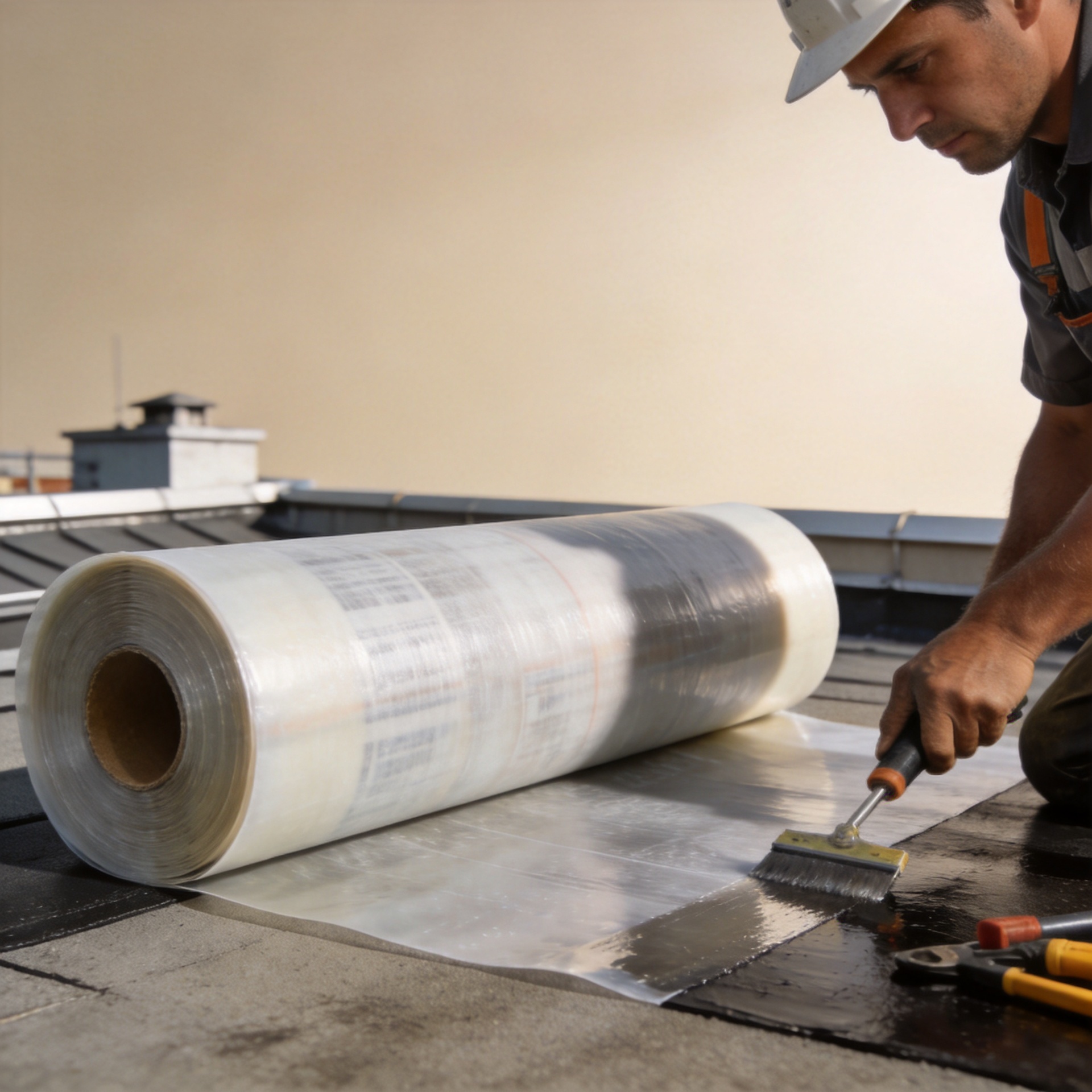
PVC waterproofing is the single-ply choice when a project needs welded seams, high elongation and documented European test data in one material. Specified on flat roofs, tunnel linings and containment basins, it carries EN 13956 certification and a pvc roofing membrane grade for industrial decks. This article reads the published data and compares three constructions.
PVC sheet is a plasticized polymer membrane whose seams are joined by hot-air welding rather than adhesive or flame. Welding fuses the edges into a continuous barrier and removes the weakest point of most systems: the lap. Because the weld is a material bond, seam strength approaches that of the sheet body. That is why pvc membrane welding dominates tunnel specifications, where laps must be verifiable.
The second difference is flexibility across temperature. Published grades certify −25°C low-temperature flexibility (EN 495-5) and 70°C heat resistance, so a pvc waterproofing membrane performs where bituminous sheet would stiffen or soften. Add resistance to dilute acids and alkalis, and pvc roofing membrane work on containment becomes straightforward.
Three constructions solve three different problems:
Published data for a homogeneous pvc membrane shows what a complete submission should contain:
|
Parameter |
Published value |
|
Thickness |
1.2 / 1.5 / 1.8 / 2.0 mm |
|
Tensile strength |
≥200 N/50mm (EN 12311-2) |
|
Elongation at break |
≥250% |
|
Dimensional stability |
≤2.0% (EN 1107-2) |
|
Water tightness |
Pass at 60 kPa (EN 1928) |
|
Low-temperature flexibility |
−25°C (EN 495-5) |
|
Heat resistance |
70°C |
|
Standards |
EN 13956, GB 12952 |
Elongation matters most: at ≥250%, the sheet redistributes strain when the substrate cracks, instead of concentrating stress at fasteners. Because a homogeneous pvc membrane carries no reinforcement, that reserve is what absorbs movement. Dimensional stability of ≤2.0% matters for the opposite reason: the sheet must not shrink or grow on an exposed deck. Ask for the EN report behind each row, not a summary table.
One pvc waterproofing membrane system covers three configurations, with thickness matched to method. A pvc roofing membrane is normally ballasted or mechanically fixed; adhered work takes the fleece grade, and each method changes the detail set:
All seams are hot-air welded with a minimum 40 mm overlap, and pvc membrane welding is checked rather than assumed: a test weld at the start of each shift, a probe or peel check along every seam, and a visual pass for gaps and scorching. Because a homogeneous pvc membrane welds identically from any face, that discipline holds in confined tunnel spaces.
Flat and complex roofs use a pvc roofing membrane for weldability at parapets, penetrations and expansion joints. Tunnel and metro linings rely on Type H elongation to follow irregular shotcrete and absorb substrate movement. Containment work — ponds, basins, sewage plants — specifies a pvc waterproofing membrane for chemical resistance, with the 60 kPa rating confirming barrier integrity under sustained hydrostatic pressure.
The fit is not universal. A pvc roofing membrane is a weaker choice where the deck cannot accept fasteners or ballast, where the sheet would sit in permanent contact with bitumen, or where the spec names a material rather than a performance. Check those conditions before the design is frozen, and confirm homogeneous pvc membrane thickness against the method.
One metro station box shows the sequence: shotcrete walls, a 1.5 mm sheet that conformed without bridging voids, details prefabricated at surface, and every weld probed section by section. The structure passed its water test first time. Published data of that kind — 1.2–2.0 mm and ≥250% elongation, as documented by Shandong Dingtai Waterproof for its Type H grade — is what lets a pvc membrane welding specification be written before fabrication begins.
PVC welds easily and offers the highest published elongation of the single-ply family. TPO suits standard decks and avoids plasticizer concerns; bitumen remains cost-effective for multi-layer build-ups. Compare EN 1928 water tightness and EN 12311-2 tensile data rather than material names, and treat any pvc waterproofing membrane claim without a test report as marketing.
Match construction to fixing method first: the Type H homogeneous pvc membrane for formability and tunnels, Type P for mechanically fastened roofs, Type L for adhered systems. Then match thickness to load: 1.2–1.5 mm adhered or fastened, up to 2.0 mm for ballasted or high-pressure work. A published table mapping thickness to method is a good sign of a complete pvc waterproofing membrane datasheet.
Baseline: EN 13956 conformance, EN test reports for each parameter above, COA, MSDS, TDS and ISO 9001 for the plant. For tunnelling, add welding procedure documentation and offcuts, so pvc membrane welding on site can be checked against the certified reference. Where several suppliers quote pvc roofing membrane grades, request the same package from each, and compare it as a homogeneous pvc membrane order, not a price.

2026/11/20
How an APP waterproof membrane handles heat: 130°C softening point, torch application windows, overheating signs, summer storage, and thermal aging checks.

2026/11/20
The science of a breathable waterproof membrane: water vapor diffusion, Sd values, three grammage grades, water column resistance, and wrong-use cases.

2026/11/20
Single-ply or two-ply, every flat roof is a stack. See how a self adhesive waterproof membrane for roof systems handles base, cap, insulation and drains.

2026/11/20
How the polyester scrim sets tensile strength and dimensional stability of reinforced TPO membrane rolls, with welding, roll sizes and selection tips.

2026/11/20
How an aluminum foil coated bitumen waterproof membrane reflects solar radiation, lowers surface temperature, and what maintenance keeps savings alive.

2026/11/20
SBS modified bitumen waterproof membrane property groups: tensile strength, low-temperature flexibility, heat resistance, surface finishes, applications.
Links to the corresponding full news page.

The eight questions overseas buyers ask most — factory ownership, capacity, batch consistency and lead times, answered straight.

SBS membranes, polymer sheets, coatings and geomembranes — six product lines are operating simultaneously.

Pre-sales specification, on-site technical support and post-delivery maintenance across 100+ export markets.

Waterproofing performance is decided in the specification and the detailing, not just the material. Our technical team helps you select the right system, resolve site questions as they arise, and stay reachable long after the container lands.
