 EN
APP Waterproof Membrane: High-Temperature Stability Guide
2026/11/20
How an APP waterproof membrane handles heat: 130°C softening point, torch application windows, overheating signs, summer storage, and thermal aging checks.

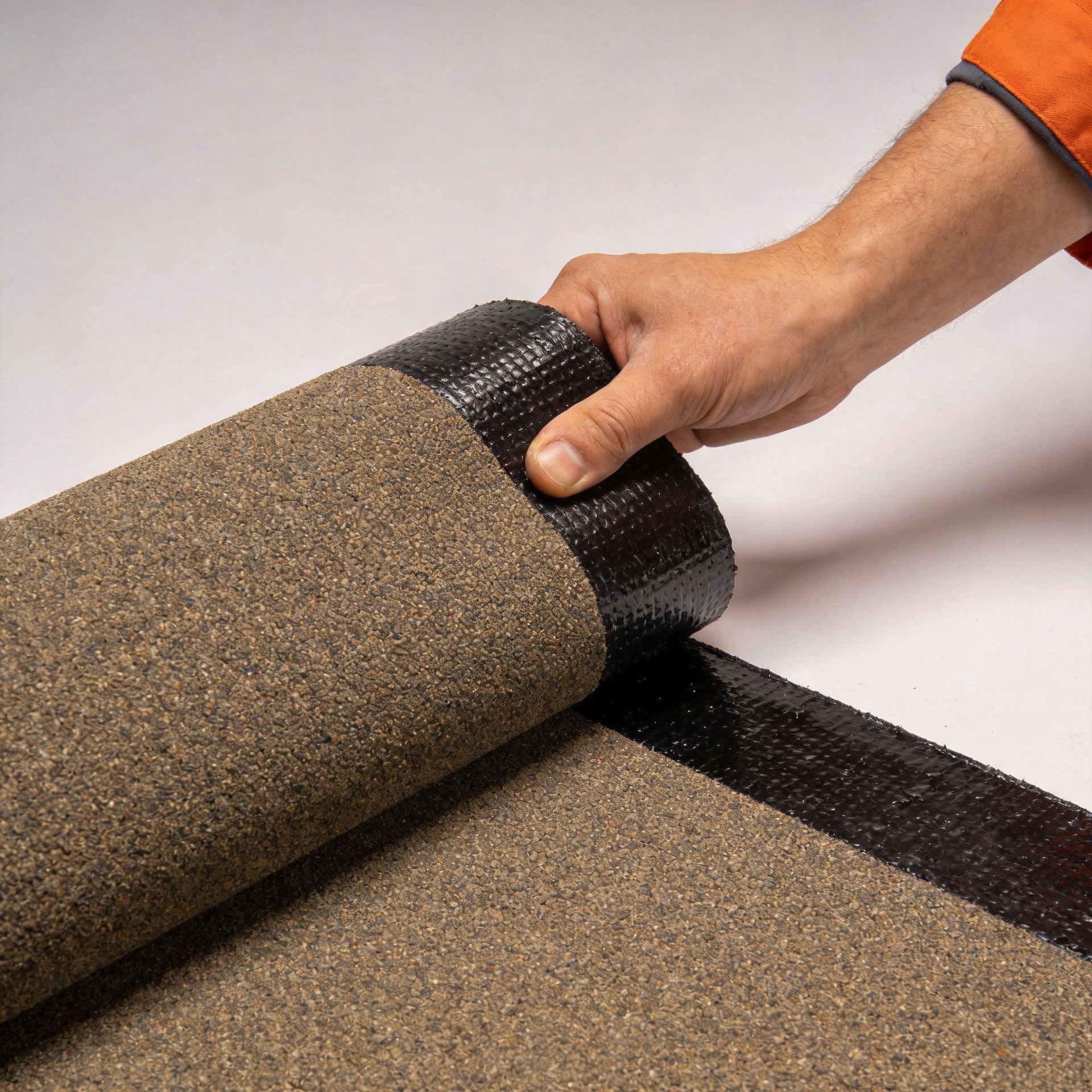
Two rolls can carry the same compound, reinforcement, and thickness and still behave differently on a roof. The difference is the top surface. A sand surface sbs bitumen waterproof membrane is finished with fine mineral grains that change how the roll unwinds and how the next ply bonds. This article explains how a mineral granule finish behaves beside a PE film face, what an aluminium foil face adds, and what to inspect on delivery.
The finish is applied during manufacture, while the bitumen is still hot. Fine grains are broadcast and embedded in the compound, so the face presents a dense, matte texture. It is not a coating that can peel away, and on a sand surface sbs bitumen waterproof membrane the grains sit in the bitumen skin, which is why the finish survives winding and transport. A PE film face is a separate sheet pressed onto the compound and stripped away or burned off later.
Rolls are wound while the compound is still warm, and two bitumen faces pressed together will bond if nothing separates them. The mineral granule finish acts as that separator, which is why a sand-faced roll can be stacked and shipped without a release liner, with the PE film kept clean on the reverse. Storage still matters: a pallet left in direct sun can soften the compound enough for grains to press into the face below, and the roll will block. Shade and side storage protect every finish, since an aluminium foil face creases under the same handling.
Roofs are walked on: crews reach plant, inspectors check laps, installers cross the deck. On a sand surface sbs bitumen waterproof membrane, the granular face gives grip that a smooth bitumen surface does not, particularly when the roof is damp or dusty, and a mineral granule finish reduces slipping during detail work. Protection boards are still needed for access. An aluminium foil face reflects heat but offers less grip underfoot, which is why the two finishes rarely appear on the same exposed terrace.
In a multi-ply torch system the surface decides how layers fuse. Bitumen bonds to bitumen, so a heated mineral granule finish melts into the ply above. The film face must be burned off completely before that bond can form at all, and any film left intact becomes a slip plane between plies. That is why this face is common on the upper ply, where fusion matters and the sheet takes traffic.
The three finishes answer different questions. A PE film is the cheapest way to stop a roll sticking, and it suits sheets that will be covered or buried. A sand surface sbs bitumen waterproof membrane sits between the extremes: a mineral granule finish takes traffic, gives the next ply a surface to key into in a two-layer roof system, and leaves a finished appearance without the glare of foil. An aluminium foil face is chosen for reflection, not for wear underfoot. On the upper ply, where traffic and bonding both matter, a sand surface sbs bitumen waterproof membrane earns its cost.
Start with the family numbers: thickness grades of 3 mm, 4 mm, and 5 mm, a roll size of 1 m × 10 m, tensile strength at or above 800 N/50mm, elongation at or above 40%, low-temperature flexibility at -25°C, and heat resistance at 90°C, assessed against GB 18242 or EN 13707. Then inspect the finish and the PE film backing: coverage should be uniform across the full width, grains embedded rather than loose in the wrapper, and a backing free of creases. An aluminium foil face should be checked for creases at the lap line, where water can collect after rain. Loose grit in the mineral granule finish suggests the roll was wound too hot, and a PE film backing that has wrinkled points to the same handling problem.
For a fully exposed terrace, a self-adhesive coloured sand sheet is a different option, which belongs to another product category: 1.5 mm thick, peel adhesion at or above 1.5 N/mm, tensile strength at or above 400 N/50mm, flexibility to -15°C, heat resistance at 90°C, and a minimum order of 500 m². It is cold-applied, so it suits occupied buildings where open flame is restricted. An aluminium foil face would reflect more, but it cannot be walked on.
One project team specified a 4 mm sand surface sbs bitumen waterproof membrane for a school roof terrace. The surface took foot traffic without slipping, the cap sheet adhered at every lap, and two years on the grit was still embedded.
The terms overlap. Both describe fine mineral material embedded in the bitumen surface, and suppliers use sand, slate granule, or coloured granule. Coverage and bonding matter more than the label on the datasheet.
It can, but a PE film is usually better and cheaper where a sand surface sbs bitumen waterproof membrane will be covered, and an aluminium foil face does not change that. Sand is specified for the face that will be exposed, walked on, or bonded to another ply, which is where the mineral granule finish earns its place.
No. Watertightness comes from the compound and the reinforcement that carries the load, not from the decorative finish alone. An aluminium foil face changes reflection, not watertightness. The surface decides blocking, grip, and interlayer bonding, which is why a sand surface sbs bitumen waterproof membrane is specified by face rather than by thickness. PE film choice follows the same logic.

2026/11/20
How an APP waterproof membrane handles heat: 130°C softening point, torch application windows, overheating signs, summer storage, and thermal aging checks.

2026/11/20
The science of a breathable waterproof membrane: water vapor diffusion, Sd values, three grammage grades, water column resistance, and wrong-use cases.

2026/11/20
Single-ply or two-ply, every flat roof is a stack. See how a self adhesive waterproof membrane for roof systems handles base, cap, insulation and drains.

2026/11/20
How the polyester scrim sets tensile strength and dimensional stability of reinforced TPO membrane rolls, with welding, roll sizes and selection tips.

2026/11/20
How an aluminum foil coated bitumen waterproof membrane reflects solar radiation, lowers surface temperature, and what maintenance keeps savings alive.

2026/11/20
SBS modified bitumen waterproof membrane property groups: tensile strength, low-temperature flexibility, heat resistance, surface finishes, applications.
Links to the corresponding full news page.

The eight questions overseas buyers ask most — factory ownership, capacity, batch consistency and lead times, answered straight.

SBS membranes, polymer sheets, coatings and geomembranes — six product lines are operating simultaneously.

Pre-sales specification, on-site technical support and post-delivery maintenance across 100+ export markets.

Waterproofing performance is decided in the specification and the detailing, not just the material. Our technical team helps you select the right system, resolve site questions as they arise, and stay reachable long after the container lands.
