
 EN
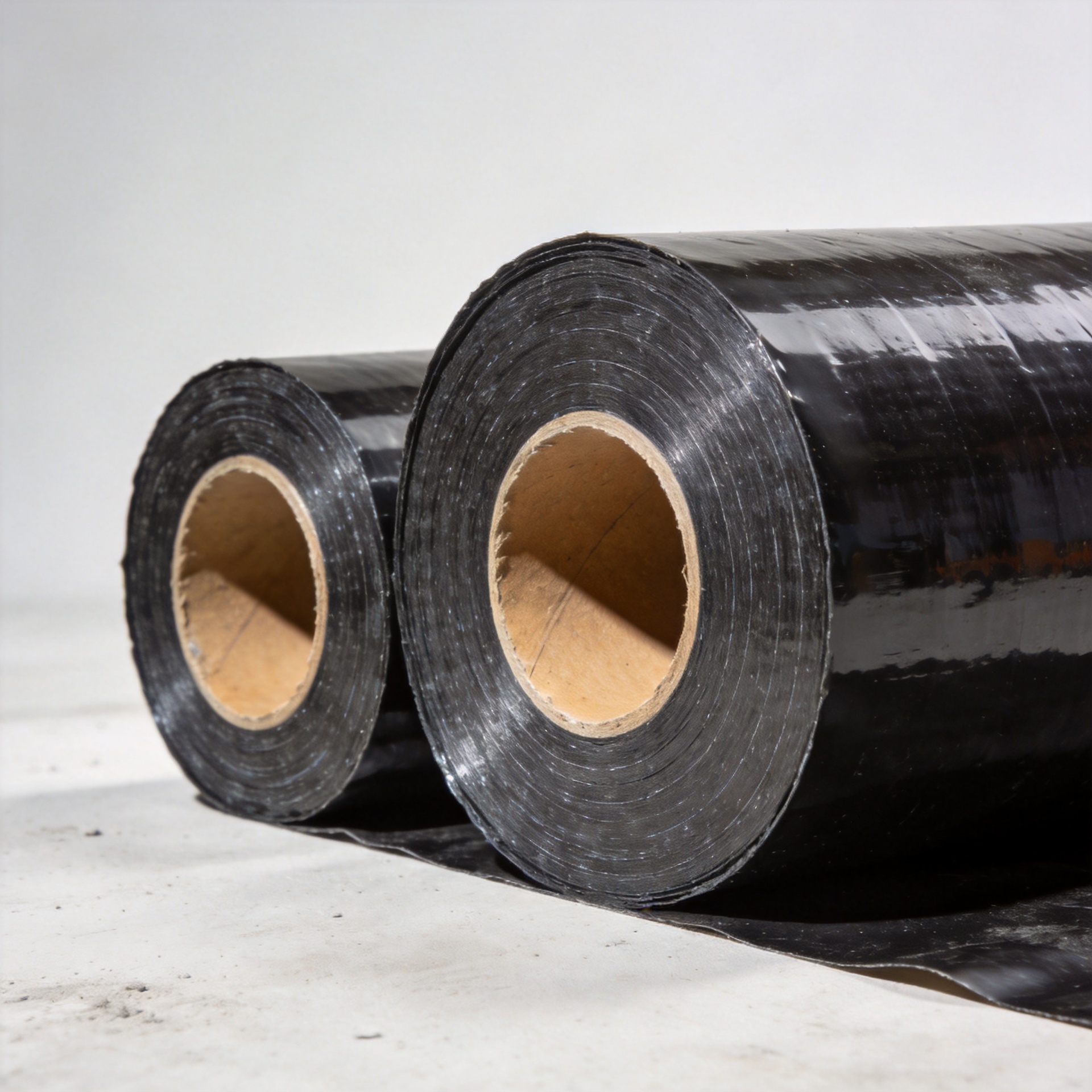
A 10m roll and a 20m roll of the same sheet behave like different products on site, and the difference appears in laps and offcuts rather than in the data sheet. Buyers who order by area alone meet that gap at the last bay of a deck, where a membrane roll size that does not divide into the run leaves a strip too narrow to lay. This guide compares the two standard lengths, follows a self adhesive membrane roll from pallet to roof, shows where a custom roll width earns its extra cost, and sets out the handling rules.
The Two Standard Rolls
The common supply of self adhesive waterproof membrane sheeting is 1m × 10m and 1m × 20m, both 1.2mm with a smooth PE film face and the same figures: peel adhesion ≥1.5 N/mm, tensile strength ≥300 N/50mm, elongation ≥30%, flexibility at -20°C and water tightness at 0.3 MPa for 120 minutes. The coloured sand grade is 1.5mm, 1m × 10m, ≥400 N/50mm, -15°C and 90°C, from 500 m². That is the first membrane roll size decision, because a 10m roll climbs a ladder and turns a corner while a 20m roll halves the laps. Compare a self adhesive membrane roll only at equal length, since a custom roll width quoted alone is not a like-for-like price.
Choosing a Size for the Deck
Divide the longest straight run by the roll length. On a 25m deck a 10m roll leaves a 5m piece that may serve another area, and a 20m roll leaves the same piece with half the laps to press. That is the trade a membrane roll size makes: handling against lap count.
Width works differently. A 1m roll suits corridors, plant rooms and residential slabs, while a wide roof laid with two 1m self adhesive waterproof membrane sheeting rolls gains a lap down the middle. Where that lap repeats, a custom roll width removes it and the saving lands in labour rather than material. Fewer laps also mean fewer edges for a self adhesive membrane roll to lift, which is where many callbacks begin. A membrane roll size picked for speed rather than for the run usually costs more in laps than it saves.
Take-Off, Laps and Waste
Area divided by roll area is the wrong number. Add the lap allowance on every course, the upstand height at each edge, a trim allowance at penetrations, and the offcut too short to reuse. Then round up to whole rolls, because nobody ships two thirds of a self adhesive waterproof membrane sheeting roll.
Details change the arithmetic. A roof full of pipes and drains consumes more small pieces than a clean slab, counted or not. A take-off that ignores details becomes a second delivery of a self adhesive membrane roll, and a second delivery is where a custom roll width stops looking expensive.
Slitting and Detail Strips
Factories slit self adhesive waterproof membrane sheeting into narrow rolls for flashings, joint strips and repairs, often the cheapest detail material. PE-faced 1.2mm sheeting runs from 50mm to 300mm and up to 1000mm, while foil-faced 1.5mm tape covers 100mm to 600mm in 7.5m to 20m lengths, and a self adhesive membrane roll of that width often replaces field cutting. A custom roll width inside that range removes site cutting, and with it the ragged edge left by a knife.
Order narrow rolls with the field material. Slitting afterwards means the plant reopens a self adhesive waterproof membrane sheeting pack built to another specification, and a membrane roll size that was already palletised has to be rebuilt before it can ship.
Pallets, Containers and Storage
Rolls travel upright, standing on the core rather than lying on the adhesive, with the pallet footprint matched to the container floor. Horizontal stacking flattens a self adhesive membrane roll and shifts load onto the lap edge, which returns as a wrinkle that will not press down. State the membrane roll size and pallet pattern in the order, so the loader knows which face is protected.
Storage repeats the factory rules: upright, shaded, on bearers, nothing stacked on top. Heat softens the compound and cold stiffens the adhesive, and either one makes a custom roll width harder to lay flat.
Handling on Site
Open rolls last, and only those going down that day. A roll left open overnight collects dust on the adhesive face, and dust is the commonest reason a peel figure of ≥1.5 N/mm does not appear on site. Carry on a bar through the core, not on a shoulder, and do not drag a self adhesive waterproof membrane sheeting roll across a finished lap.
On a terrace job, 20m rolls were ordered for a run too short to use them. When a custom roll width arrives, record the bay it served and what remained, because the next phase will want that figure rather than a fresh guess.
Frequently Asked Questions
Is a 20m roll cheaper per square metre?
Usually, because there are fewer laps and less handling, but only if the deck can use the length; a wider membrane roll size does not help a short run. Compare cost per installed square metre of self adhesive waterproof membrane sheeting, not per roll, and ask what a self adhesive membrane roll costs landed.
Can I mix roll lengths in one order?
Yes, and mixed orders suit projects with a large deck plus small rooms. State the split at quotation, because a custom roll width changes the packing plan and the loading sequence.
Does width affect the warranty?
It affects lap count, and laps are where failures start. A wider membrane roll size reduces laps, but only if the crew can carry the weight and keep a self adhesive membrane roll aligned during placement.










