 EN
APP Waterproof Membrane: High-Temperature Stability Guide
2026/11/20
How an APP waterproof membrane handles heat: 130°C softening point, torch application windows, overheating signs, summer storage, and thermal aging checks.

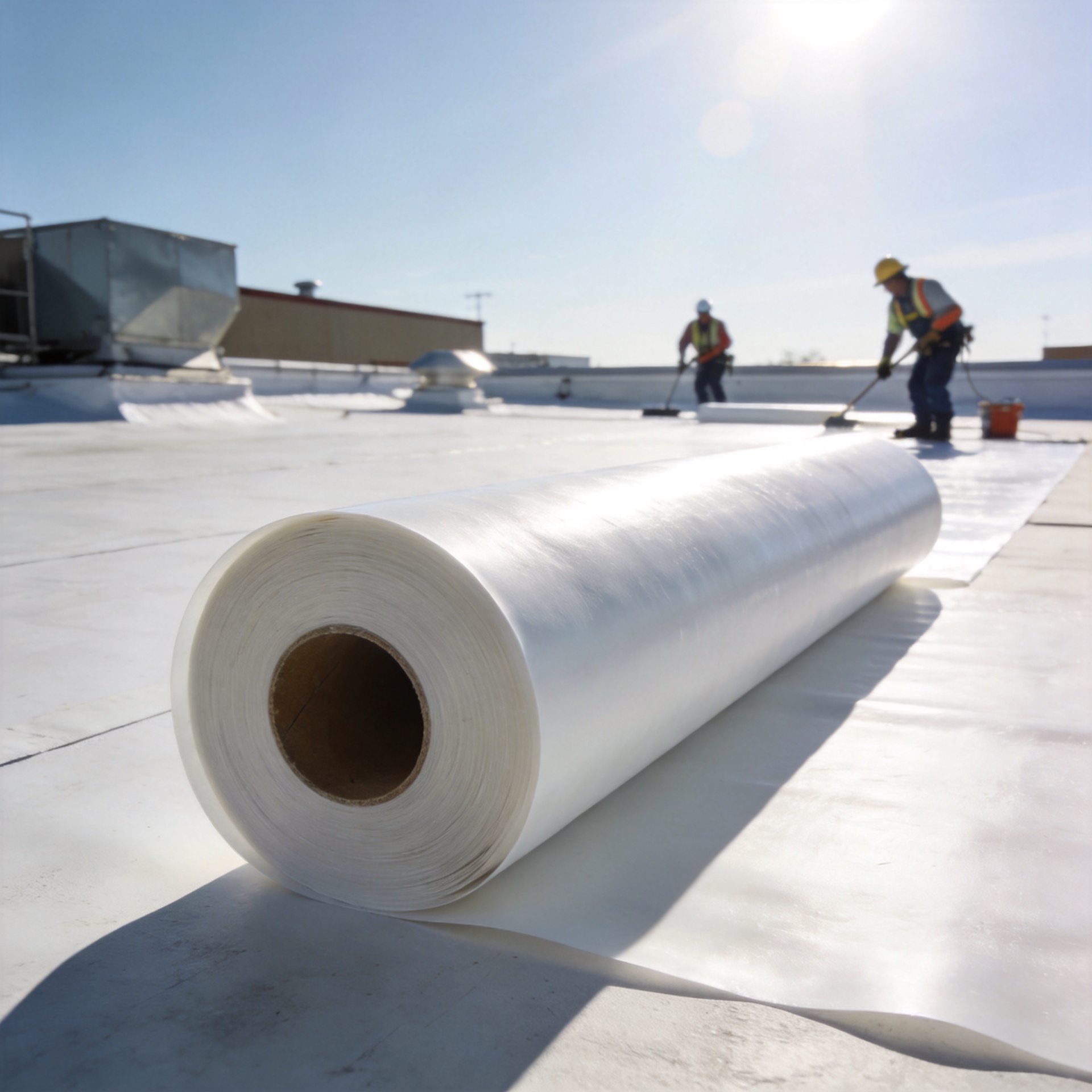
Uncovered roofing takes full solar load year after year, so ultraviolet durability is the first selection filter. This guide explains how sunlight ages plasticized PVC, which published parameters matter most, and where reflective TPO changes the comparison — a read-through for anyone specifying a uv resistant PVC waterproof membrane roof.
Sunlight attacks single-ply sheet in two ways. Photo-oxidation degrades the polymer surface, which shows up first as chalking and discoloration; heat accelerates the migration of plasticizer out of the compound, which gradually reduces flexibility. These general aging mechanisms explain why an exposed roof punishes a thin, poorly stabilized sheet before a well-formulated one. Because the data sheets publish no UV-hour rating, the approach is indirect: choose thickness with reserve, reinforcement controlling dimensional change, and weld values verifiable via batch certificates. Every shortcut at specification stage returns faster in full sun.
The range offers two structures, both documented against EN 13956 and GB 12952. Type H is a homogeneous, unreinforced plasticized sheet: the compound runs through the full cross-section, giving elongation at break of ≥ 250%, tensile strength ≥ 200 N/50mm (EN 12311-2), and free formability around penetrations and parapets. Type P embeds a polyester fiber scrim: tensile strength rises to ≥ 900 N/50mm longitudinal and ≥ 800 N/50mm transverse, while elongation is ≥ 15%. For a uv resistant PVC waterproof membrane roof, the scrim matters because daily heat cycling works the sheet; the polyester core limits the dimensional growth that temperature swings would impose on an exposed roof.
Both types come in 1.2mm, 1.5mm, 1.8mm, and 2.0mm, with widths of 1.0m, 1.5m, and 2.0m. Thickness is the UV reserve: a thicker section takes longer for surface degradation to matter, so open-weather specifications gravitate to 1.8mm and 2.0mm. Dimensional stability comes next. Type P holds ≤ 0.1% (EN 1107-2) — tight enough to keep hot-air welding laps closed through years of thermal cycling — while Type H allows ≤ 2.0%. Low-temperature flexibility at -25°C (EN 495-5) and water tightness at 60 kPa (EN 1928) complete the EN 13956 test picture for either structure. These published lines are what a uv resistant PVC waterproof membrane roof spec should quote verbatim.
Long-term failures concentrate at seams, and welding quality decides seam life. Hot-air welding produces a homogeneous joint: Type P reaches seam shear resistance ≥ 900 N/50mm, matching the base sheet's longitudinal rating within the EN 13956 framework, and every thickness requires a minimum 40mm overlap with no adhesives or tapes. Because the weld fuses sheet to sheet, seams can be peel-tested on site as an objective workmanship check — a real advantage where wind uplift loads every lap of an exposed roof. Ask whether weld parameters appear in the installation datasheet; consistent records make weld quality auditable across crews. On a uv resistant PVC waterproof membrane roof, seam records are the audit trail.
Surface temperature drives both heat aging and cooling cost, and it changes what hot-air welding joints must endure. The manufacturer's TPO Type P page publishes SRI ≥ 104 for white and light grey surfaces — citable for cool-roof requirements — and notes surface-temperature reductions of 40–60°C versus dark roofing under peak solar load. PVC in this range is supplied in grey, white, green, and custom RAL colors, so a light shade narrows the thermal gap on an exposed roof, though the published SRI figure belongs to the TPO product. If reflectivity drives your tender, mind that asymmetry: one page publishes the number, the other offers color choice plus the same hot-air welding single-ply system. A uv resistant PVC waterproof membrane roof tender should ask which figures each page publishes.
Confirm the structure first: Type H for complex geometry and elongation, Type P for mechanically fastened wind-uplift resistance. Choose 1.8–2.0mm for permanent service on an exposed roof. Demand EN 13956 and GB 12952 compliance, Type P's ≤ 0.1% dimensional stability where seams dominate, and batch certificates for elongation and water tightness, plus hot-air welding procedure records. MOQ starts from 2,000 m², with OEM, private-label options, and export documentation including EN test reports, COA, MSDS, and TDS. A uv resistant PVC waterproof membrane roof is ultimately specified through these five lines, not marketing language.
A contractor refurbishing a coastal warehouse chose 2.0mm Type P after reviewing the datasheet: the ≥ 900 N/50mm tensile rating allowed wider fastener spacing on long spans, the 40mm weld overlap gave a testable seam standard, and the light grey color moderated surface temperatures on the exposed roof during a cool-roof submission.
Type P for most flat roofs: the polyester scrim holds dimensional change to ≤ 0.1% and delivers ≥ 900 N/50mm tensile strength for mechanically fastened systems with hot-air welding seams. Type H remains the choice where ≥ 250% elongation matters more than wind-uplift ratings on an exposed roof. Both structures carry EN 13956 certification, so the difference is mechanics, not compliance.
No. The pages publish elongation, tensile strength, dimensional stability, water tightness, and temperature values, but no UV-hour rating. Specify a uv resistant PVC waterproof membrane roof through thickness reserve, reinforcement, and hot-air welding quality, and request batch certificates for published values. Documentation is the audit trail for a specification written this way.
The TPO Type P page publishes SRI ≥ 104 for white and light grey surfaces, which supports cool-roof files. PVC here offers grey, white, green, and custom RAL colors with the same 40mm hot-air welding system, so compare the two on published figures before writing an exposed roof specification.

2026/11/20
How an APP waterproof membrane handles heat: 130°C softening point, torch application windows, overheating signs, summer storage, and thermal aging checks.

2026/11/20
The science of a breathable waterproof membrane: water vapor diffusion, Sd values, three grammage grades, water column resistance, and wrong-use cases.

2026/11/20
Single-ply or two-ply, every flat roof is a stack. See how a self adhesive waterproof membrane for roof systems handles base, cap, insulation and drains.

2026/11/20
How the polyester scrim sets tensile strength and dimensional stability of reinforced TPO membrane rolls, with welding, roll sizes and selection tips.

2026/11/20
How an aluminum foil coated bitumen waterproof membrane reflects solar radiation, lowers surface temperature, and what maintenance keeps savings alive.

2026/11/20
SBS modified bitumen waterproof membrane property groups: tensile strength, low-temperature flexibility, heat resistance, surface finishes, applications.
Links to the corresponding full news page.

The eight questions overseas buyers ask most — factory ownership, capacity, batch consistency and lead times, answered straight.

SBS membranes, polymer sheets, coatings and geomembranes — six product lines are operating simultaneously.

Pre-sales specification, on-site technical support and post-delivery maintenance across 100+ export markets.

Waterproofing performance is decided in the specification and the detailing, not just the material. Our technical team helps you select the right system, resolve site questions as they arise, and stay reachable long after the container lands.
