 EN
APP Waterproof Membrane: High-Temperature Stability Guide
2026/11/20
How an APP waterproof membrane handles heat: 130°C softening point, torch application windows, overheating signs, summer storage, and thermal aging checks.

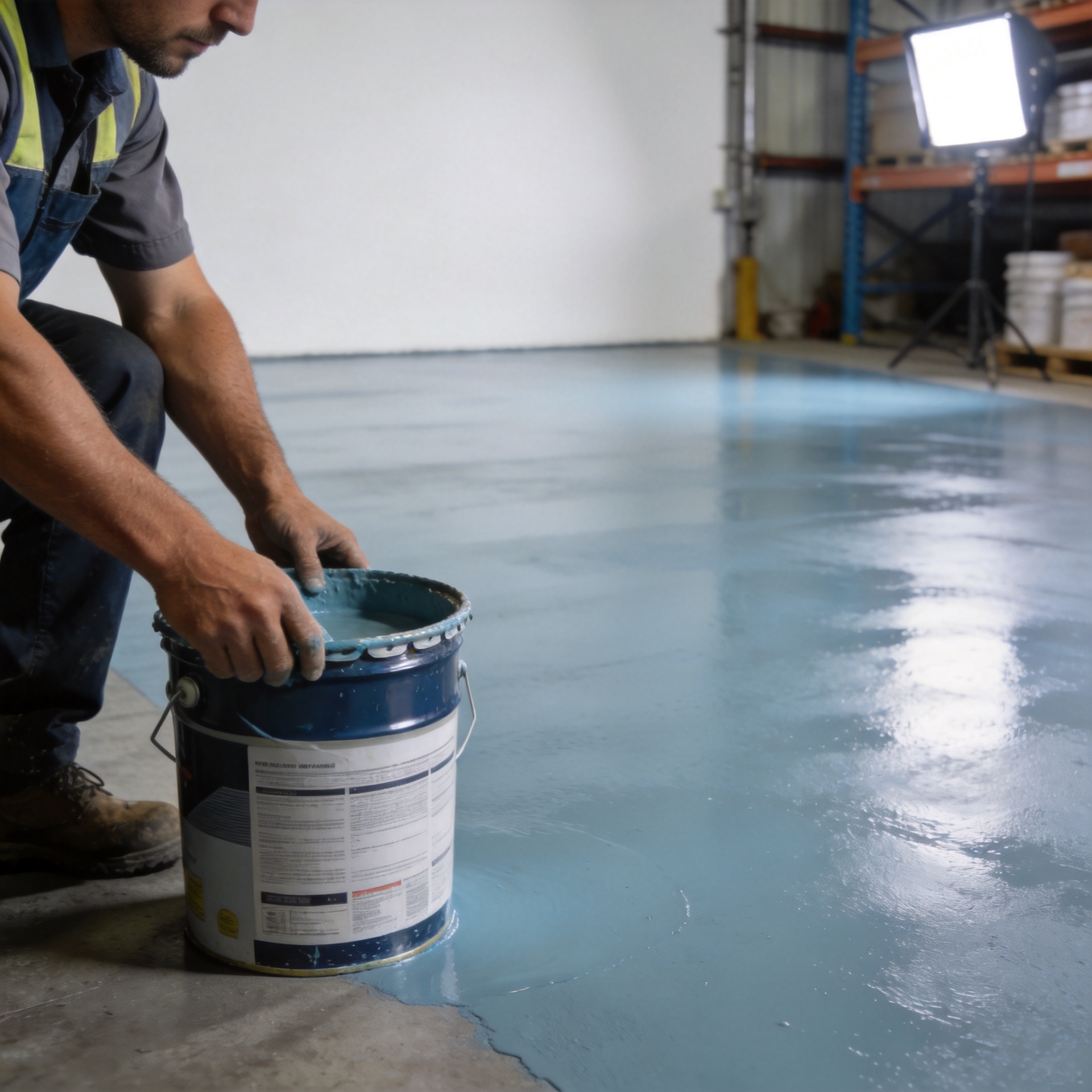
Enquiries for a water based epoxy floor keep growing among distributors and contractors alike who need a low-odour concrete floor coating for occupied buildings, because any conventional epoxy floor coating would force closures. This short guide explains how it actually forms, applies, and where it truly helps.
By definition, waterborne epoxy floor paint is always a two-component system in which epoxy resin is dispersed as microscopic particles in water rather than dissolved in solvent. Component A carries the dispersed resin; Component B supplies a water-compatible amine hardener that reacts with it as water evaporates, letting the particles coalesce into a continuous film. Because water is the only carrier, the mix has a mild odour, tools rinse in water, and volatile emissions stay far below solvent-borne chemistry. When buyers compare any conventional epoxy floor coating with a waterborne grade, the first difference is not film hardness but site behaviour: what the product releases while it cures. Specifiers who must coat hospitals or supermarkets during trading hours shortlist the low-odour option first, which is exactly where a water based epoxy system earns its place in a concrete floor coating programme.
Curing combines coalescence with chemical crosslinking. As water leaves the film, resin particles pack together and the amine hardener links them into a polymer network. Temperature therefore matters more than with solvent products: below roughly 10 °C, coalescence slows and the film can stay under-cured, so a water based epoxy system should only be applied when substrate and air temperatures sit above the minimum on the data sheet — the same rule governs every waterborne epoxy floor paint. Airflow and humidity matter too, because they govern how fast water escapes from any epoxy floor coating. For reference, the same supplier's water-based waterproof coating page specifies 2–4 hours surface dry at 20 °C and 1.5–2.0 kg/m² in two coats — useful calibration for waterborne drying, though a concrete floor coating faces far heavier traffic than a wall membrane.
Preparation decides the outcome. Grind or shot-blast the slab, repair cracks, and verify substrate moisture before any pail is opened. Clean and profile the concrete, and vacuum dust so the primer bonds. Apply a priming coat of the same water based epoxy chemistry, slightly diluted, to seal a thirsty slab. Mix Component A and B in the stated ratio, stirring slowly to avoid entraining air. Roll the first coat, keeping a wet edge. Recoat once the first coat is walkable and cross-roll for uniform build. Allow full cure before traffic. On a properly prepared concrete floor coating job, two coats at the recommended spread rate deliver the designed film thickness; thinning coats to stretch material is the most common cause of premature wear in any epoxy floor coating.
The advantages cluster around people and buildings. Odour is the headline: a water based epoxy film lets other trades keep working and allows a shop or warehouse to stay partly open during renovation. Cleanup needs only water, removing solvent handling from risk assessments. Transport and storage are simpler too, because waterborne products lack the flammability classifications of solvent-borne paints — a daily advantage for distributors who also stock a conventional epoxy floor coating. For an electronics assembly area, a floor applied over a weekend and reopened on Monday without lingering smell is worth more than a marginally harder film, which is why many procurement teams choose this chemistry over a rigid concrete floor coating for occupied-space projects.
Honesty about limits protects repeat business. A water based epoxy film generally does not match the chemical resistance or build thickness of high-solids two-component systems, so workshops with fuel splash, hot tyre pickup, or heavy forklift loading should treat waterborne epoxy floor paint as light-to-medium duty. Uncured concrete, standing water, and oil-contaminated slabs remain unsuitable for any concrete floor coating, waterborne or otherwise. Where a project demands deep chemical resistance, a conventional epoxy floor coating or a polyurethane topcoat is the more defensible specification; where it needs elasticity over a moving slab, a flexible waterproofing membrane is a different conversation. Match the chemistry to the duty, not the brochure.
Buyers sourcing waterborne epoxy floor paint for resale should request four things: a data sheet with solids content and spread rate, VOC documentation, a site-trial sample, and clarity on packaging and minimum order quantities. Testing a sample on the actual slab is the only reliable way to judge a concrete floor coating, because absorption, moisture, and temperature vary by site. Distributors building a range should also confirm the water based epoxy floor line works with the same supplier's primers and moisture-tolerant products, so a project can be sourced as a matched system. Each epoxy floor coating purchase should therefore be judged on documentation quality as much as on price per kilogram.
Only if the old coating is sound, well bonded, and abraded to a matte profile. Loose or glossy coatings cause adhesion failure. A small test patch, checked after full cure, is the safe way to confirm compatibility of any concrete floor coating.
Light foot traffic is usually possible within a day at normal temperatures, while full cure takes several days depending on temperature, humidity, and film thickness — every epoxy floor coating needs that patience. Cool or humid sites need longer, so always follow the technical data sheet.
For domestic garages and light workshops it performs well on a properly prepared slab. For commercial workshops exposed to fuel, solvents, and hot tyres, a higher-build solvent-based system outlasts any waterborne epoxy floor paint.

2026/11/20
How an APP waterproof membrane handles heat: 130°C softening point, torch application windows, overheating signs, summer storage, and thermal aging checks.

2026/11/20
The science of a breathable waterproof membrane: water vapor diffusion, Sd values, three grammage grades, water column resistance, and wrong-use cases.

2026/11/20
Single-ply or two-ply, every flat roof is a stack. See how a self adhesive waterproof membrane for roof systems handles base, cap, insulation and drains.

2026/11/20
How the polyester scrim sets tensile strength and dimensional stability of reinforced TPO membrane rolls, with welding, roll sizes and selection tips.

2026/11/20
How an aluminum foil coated bitumen waterproof membrane reflects solar radiation, lowers surface temperature, and what maintenance keeps savings alive.

2026/11/20
SBS modified bitumen waterproof membrane property groups: tensile strength, low-temperature flexibility, heat resistance, surface finishes, applications.
Links to the corresponding full news page.

The eight questions overseas buyers ask most — factory ownership, capacity, batch consistency and lead times, answered straight.

SBS membranes, polymer sheets, coatings and geomembranes — six product lines are operating simultaneously.

Pre-sales specification, on-site technical support and post-delivery maintenance across 100+ export markets.

Waterproofing performance is decided in the specification and the detailing, not just the material. Our technical team helps you select the right system, resolve site questions as they arise, and stay reachable long after the container lands.
