 EN
APP Waterproof Membrane: High-Temperature Stability Guide
2026/11/20
How an APP waterproof membrane handles heat: 130°C softening point, torch application windows, overheating signs, summer storage, and thermal aging checks.

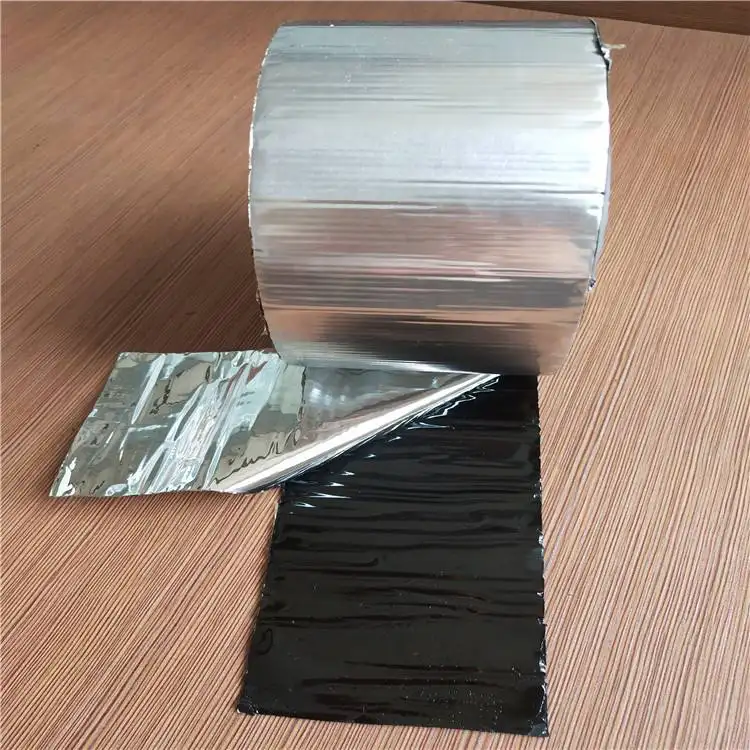
Joints are where a roof gives up water first. Four families of joints divide the surface, each failing differently: board joints between deck panels, expansion joints that split a large roof into movement bays, lap seams where sheet materials overlap, and the abutting faces of precast concrete units. A waterproof bitumen tape addresses all four because it is not a coating but a preformed sealing strip: an SBS-modified bitumen compound with a PE film or aluminum foil surface and a silicone-coated release liner. It bonds by peel-and-press, with no flame and no primer on clean dry substrates - practical high above the ground. The 1.2mm PE film grade runs 50mm to 300mm wide and the 1.5mm aluminum foil grade 100mm to 600mm, covering a narrow board joint to a wide lap seam, so matching tape width to joint width is the first selection decision.
The working rule: a waterproof bitumen tape must leave a continuous bond field on both flanks after the joint moves to its widest expected position. At roofing joints of the board type between deck panels, less width is consumed, but the tape still needs sound surface on each side; a 75mm or 100mm cut from the PE film grade covers most panel lap seams with margin. Open expansion joints consume width directly: every millimetre of expected movement subtracts from the bonded area, so joint width plus movement dictates tape width, never the reverse. Wider bays take the 1.5mm foil grade in the 100-600mm range, and the PE grade can be made to order up to 1000mm for the widest roofing joints.
Expansion joints on a roof are alive: they open on cold nights, close at midday and shear whenever adjacent bays deflect differently. A rigid filler cannot follow that cycle, which is why the SBS modifier matters in a waterproof bitumen tape: the compound stretches across the opening and recovers instead of splitting, down to the -20°C low-temperature flexibility rating. Position the tape centrally over the gap so displacement spreads into the bond field on both sides; a strip bridged taut concentrates strain at the bond line and peels inward from the ends. Both grades pass water tightness at 0.3 MPa, the value to confirm when a moving joint sits over occupied space; joint width lost to movement weakens the seal. At roofing joints that move, adhesion that survives displacement matters more than a high day-one peel number.
The 1.5mm aluminum foil grade suits exposed lines on metal roofs: standing-seam panel lap seams, ridge lines where sheets meet, anywhere the tape sees daylight. The foil shields the bitumen from UV, reflects heat from the adhesive interface, and delivers peel adhesion of at least 1.5 N/mm with tensile strength of at least 400 N/50mm. The 1.2mm PE film grade is the partner for concealed work: board joints and precast panel joints covered later by screed, where the smooth PE surface tolerates cement contact. Its peel adhesion reaches 1.2 N/mm and tensile strength 300 N/50mm in a thinner, more conformable cross-section. Choosing by position rather than price keeps each waterproof bitumen tape where its surface serves the joint.
Adhesion failures at roofing joints trace back to surface preparation more often than to the product. Joint flanks must be clean, dry and free of dust, release agents and loose scale; on rough concrete, prime before the tape goes down. Press the tape firmly with a roller from the centre outwards to push out trapped air, and overlap strip ends by a clear bonded lap so the sealing line stays continuous; confirm the joint width of every run before unrolling. On panel lap seams, centre the tape over the seam edge so it bonds equally to both sheets; at expansion joints, keep the central bridge section free of hard points that concentrate movement. Where two runs of waterproof bitumen tape meet at a corner, shingle the upper over the lower so water sheds across the splice, and roll every termination.
On a single-storey warehouse re-roof with a precast concrete deck, the contractor sealed the panel joints with the 1.2mm PE film tape at 100mm width before the covering went down, and used the 1.5mm foil grade over the metal rooflight upstands, which behave as minor expansion joints through the seasons. Both grades carried CE certification, water tightness at 0.3 MPa and -20°C flexibility, so one delivery covered the joint map. That is the practical case for waterproof bitumen tape at roofing joints: width matched to joint type, surface matched to exposure, test values matched to position. The peel and tensile figures - 1.5 N/mm and 400 N/50mm on the foil grade, 1.2 N/mm and 300 N/50mm on the PE grade - belong in the submittal, not the brochure.
No. The opening plus its movement dictates the tape width, hence the PE film grade at 50mm to 300mm and the foil grade at 100mm to 600mm, with custom widths beyond.
An overlapped seam mostly needs one continuous bonded strip along its line. Moving joints open, close and shear, so they need a wider tape centred over the gap with bond field on both flanks.
Peel adhesion, tensile strength, water tightness at 0.3 MPa and the -20°C flexibility rating, confirmed on the CE certificate and test report for the exact grade.

2026/11/20
How an APP waterproof membrane handles heat: 130°C softening point, torch application windows, overheating signs, summer storage, and thermal aging checks.

2026/11/20
The science of a breathable waterproof membrane: water vapor diffusion, Sd values, three grammage grades, water column resistance, and wrong-use cases.

2026/11/20
Single-ply or two-ply, every flat roof is a stack. See how a self adhesive waterproof membrane for roof systems handles base, cap, insulation and drains.

2026/11/20
How the polyester scrim sets tensile strength and dimensional stability of reinforced TPO membrane rolls, with welding, roll sizes and selection tips.

2026/11/20
How an aluminum foil coated bitumen waterproof membrane reflects solar radiation, lowers surface temperature, and what maintenance keeps savings alive.

2026/11/20
SBS modified bitumen waterproof membrane property groups: tensile strength, low-temperature flexibility, heat resistance, surface finishes, applications.
Links to the corresponding full news page.

The eight questions overseas buyers ask most — factory ownership, capacity, batch consistency and lead times, answered straight.

SBS membranes, polymer sheets, coatings and geomembranes — six product lines are operating simultaneously.

Pre-sales specification, on-site technical support and post-delivery maintenance across 100+ export markets.

Waterproofing performance is decided in the specification and the detailing, not just the material. Our technical team helps you select the right system, resolve site questions as they arise, and stay reachable long after the container lands.
