 EN
APP Waterproof Membrane: High-Temperature Stability Guide
2026/11/20
How an APP waterproof membrane handles heat: 130°C softening point, torch application windows, overheating signs, summer storage, and thermal aging checks.

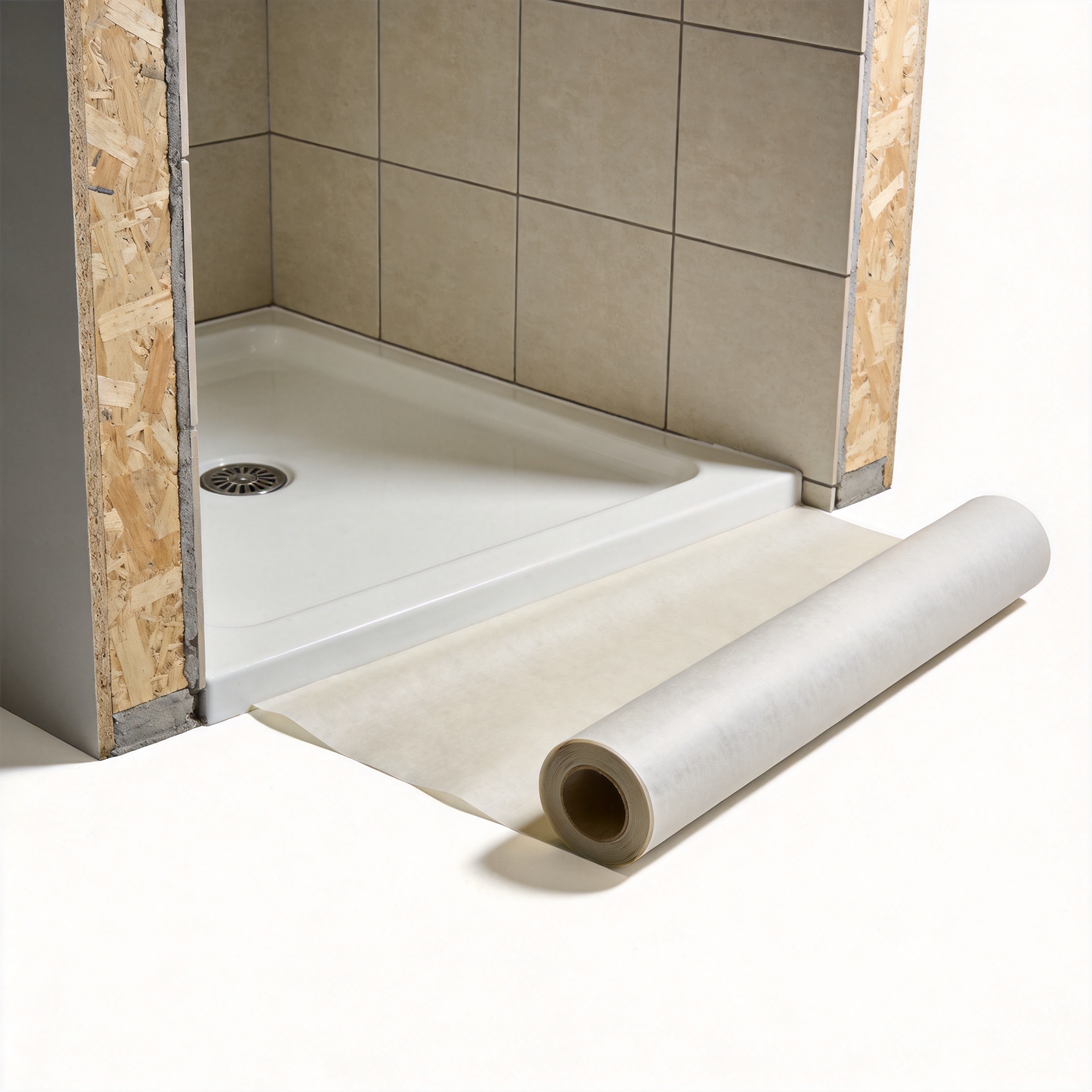
A shower is the harshest room in a house: standing water, temperature swings, and a tile finish that must stay bonded for years. Comparing options for a waterproof membrane for tile shower installations means comparing four systems, and what matters is not thickness but bond strength, corners and repair cost. Each earns its place in shower waterproofing for a different reason.
This seamless route starts as liquid polyurethane, brushed onto the substrate and cured into one continuous film. The data sheet gives elongation of at least 450 percent, applied at 1.5 to 2.5 kg/m² depending on coats. That elongation absorbs movement at wall-floor junctions, and no laps sit inside the wet zone. Corners take reinforcing fabric bedded into the first coat, and the film follows any geometry without pre-formed pieces. It tolerates vibration and flexible substrates, which is why timber-framed showers often specify it. Costs sit in labour and cure time: coats must dry in sequence, thickness is verified by consumption, and thin spots stay invisible until testing, the everyday reality of a liquid polyurethane build.
A cementitious coating is the familiar route: powder plus resin, brushed in two coats, compatible with the adhesives that follow. Rigid or semi-rigid grades give a surface tile adhesive bonds to naturally, and tile can follow after a short cure, which compresses the schedule. Damp substrates are tolerated better, and every tiler knows the material. Elongation is modest next to a liquid polyurethane film, so movement joints and corner mesh do more work. In practice a cementitious coating remains the default shower waterproofing layer across much of the world.
A PE/PP composite sheet is a factory-made waterproof membrane for tile shower work, faced for bonding into cementitious slurry. The range runs three tiers: 100 to 200, 300 to 400 and 500 to 600 g/m²; tensile strength 60, 100 or 150 N/50mm; elongation 200, 150 or 100 percent; impermeability 0.3, 0.4 or 0.6 MPa, under GB/T 17643. Thickness is uniform because it is manufactured, so the film at a niche equals the film in the field. Corners and junctions use pre-formed or folded pieces rather than build-up. The trade-off is joints: every overlap is a seam in a wet zone, seam quality depends on the bedding layer, and the bond strength of that layer decides the seam. It pairs with thin-bed tile adhesive directly.
A PVC sheet brings fused seams: Type H material runs 1.2 to 2.0 mm thick, elongation at least 250 percent, tensile at least 200 N/50mm, impermeability tested at 60 kPa under EN 1928, with 40 mm welded laps and certification to EN 13956 or GB 12952. Welded laps in shower waterproofing are a genuine advantage: the joint is fused, not glued, and a probe shows immediately whether it is continuous. The drawbacks are geometry and fixing: PVC needs a fixed or bonded layout with welded corner pieces, and tile adhesive does not bond to bare PVC, so the waterproof membrane for tile shower sandwich needs a cementitious coating bridge between sheet and tile.
Whatever the sheet, the question that decides the system is adhesion on the tile side, and honesty is required: tile bond strength is not published in these sheets. No figure for adhesion to tile appears for the liquid, the sheet or the coating ranges, and none should be assumed. The verification in shower waterproofing is a pull-off test: bond sample tiles onto a prepared waterproof membrane for tile shower mock-up, let the adhesive cure fully, then pull and read the failure mode against the specification. Between the membrane and the tile sits the adhesive; on the substrate side sits primer or slurry, and both interfaces can fail independently. The pull-off result is the only bond strength number that exists for your batch.
Every choice of waterproof membrane for tile shower work is really a choice about repair exposure. A liquid polyurethane film that fails a flood test is reopened by recoating the leak area, the mildest repair in shower waterproofing. A cementitious coating fails locally and is patched, though the patch's bond strength must be verified before tiling resumes. Sheet systems fail differently: a leaking seam means opening tiles to reach it, which is why flood testing before tiling matters more. On schedule, coatings add cure days; sheets lay fast but need careful seam work. On cost, liquid polyurethane is the heaviest material at 1.5 to 2.5 kg/m² consumption, sheets are lightest to ship, and a cementitious coating sits between; the decisive cost is the one after a leak. On one hotel renovation with occupied floors below, every pan was flood-tested before a single tile went down; the two pans that failed were recoated before anyone checked in.
A flexible one. Elongation matters more on a moving deck, so a waterproof membrane for tile shower use on timber must flex: a liquid polyurethane film or a high-tier composite sheet, while rigid layers push movement into the tile bed.
A pull-off test on the actual materials, failure mode recorded. Published bond strength figures do not exist for these products, so a specification naming a number must schedule the test before shower waterproofing production, not after a dispute.
A liquid polyurethane build runs two or more coats to reach 1.5 to 2.5 kg/m², a cementitious coating runs two, and sheets are single layer with laps or welds at every junction of the waterproof membrane for tile shower area.

2026/11/20
How an APP waterproof membrane handles heat: 130°C softening point, torch application windows, overheating signs, summer storage, and thermal aging checks.

2026/11/20
The science of a breathable waterproof membrane: water vapor diffusion, Sd values, three grammage grades, water column resistance, and wrong-use cases.

2026/11/20
Single-ply or two-ply, every flat roof is a stack. See how a self adhesive waterproof membrane for roof systems handles base, cap, insulation and drains.

2026/11/20
How the polyester scrim sets tensile strength and dimensional stability of reinforced TPO membrane rolls, with welding, roll sizes and selection tips.

2026/11/20
How an aluminum foil coated bitumen waterproof membrane reflects solar radiation, lowers surface temperature, and what maintenance keeps savings alive.

2026/11/20
SBS modified bitumen waterproof membrane property groups: tensile strength, low-temperature flexibility, heat resistance, surface finishes, applications.
Links to the corresponding full news page.

The eight questions overseas buyers ask most — factory ownership, capacity, batch consistency and lead times, answered straight.

SBS membranes, polymer sheets, coatings and geomembranes — six product lines are operating simultaneously.

Pre-sales specification, on-site technical support and post-delivery maintenance across 100+ export markets.

Waterproofing performance is decided in the specification and the detailing, not just the material. Our technical team helps you select the right system, resolve site questions as they arise, and stay reachable long after the container lands.
